How to Choose a Footwear Design Course: What Actually Matters

Footwear education is unusually opaque. Two courses with the same name can differ by three years and twenty thousand euros, and the expensive one is not reliably the better one for what you want to do. The gap that matters is not price or prestige — it is whether the course ends with you able to produce something a factory can use.
Key Takeaways
- Four formats exist — degree, technical diploma, short course, online — and they lead to different jobs, not to different amounts of the same job.
- The single most predictive question is what you can produce on the last day: a portfolio of concepts, or a graded pattern with a tech pack.
- Software matters more than most prospectuses admit. Technical offices hire for footwear CAD fluency; general 3D skills do not substitute.
- A tutor with current industry practice beats an institution with a reputation, for technical work.
- Recognition is not a regulated thing in footwear. There is no licensing body, so "certified" means whoever issued it.
The Four Formats, and What Each One Is For
University degree (BA/MA, 3-4 years)
Institutions like the London College of Fashion (UAL), FIT in New York, Istituto Marangoni and ArtCenter run footwear within fashion or product design faculties.
What you get: design methodology, research and concept development, critique culture, a peer network, and the credential itself. Strong preparation for creative and brand-side roles.
What to check: how many hours are on footwear specifically versus general fashion, and how much of the course is technical. Many programmes are strong on concept and thin on construction, which is fine if you want a design role and a problem if you want a technical one.
Cost and time: highest of the four, by a wide margin.
Technical school / diploma (months to a year)
The footwear districts have their own institutions: Arsutoria School in Milan, Politecnico Calzaturiero near Padua, and equivalents in Spain and Portugal. These grew out of the industry rather than out of academia.
What you get: construction, pattern engineering, materials, manufacturing process — taught by people who have worked in production. This is the route that produces employable technicians.
What to check: whether the course requires being physically present on a fixed schedule, and whether the software taught is what the industry actually runs.
Short course / workshop (days to weeks)
Shoemaking workshops, brand-run masterclasses, single-topic intensives.
What you get: a specific skill, or a realistic taste of whether you like the work. Genuinely useful for testing interest before committing money.
What to check: be clear with yourself that a weekend does not make you employable. That is not a criticism of short courses — it is what they are for.
Online course (self-paced)
Ranges widely in quality, from marketplace listings to structured professional programmes.
What you get: access without relocating, and the ability to work at your own pace around a job. The good ones teach a full workflow; the weak ones are a series of disconnected tutorials.
What to check: whether the course teaches professional software or a hobbyist tool, and whether it ends with a complete piece of work or a set of exercises.
The Question That Predicts Everything
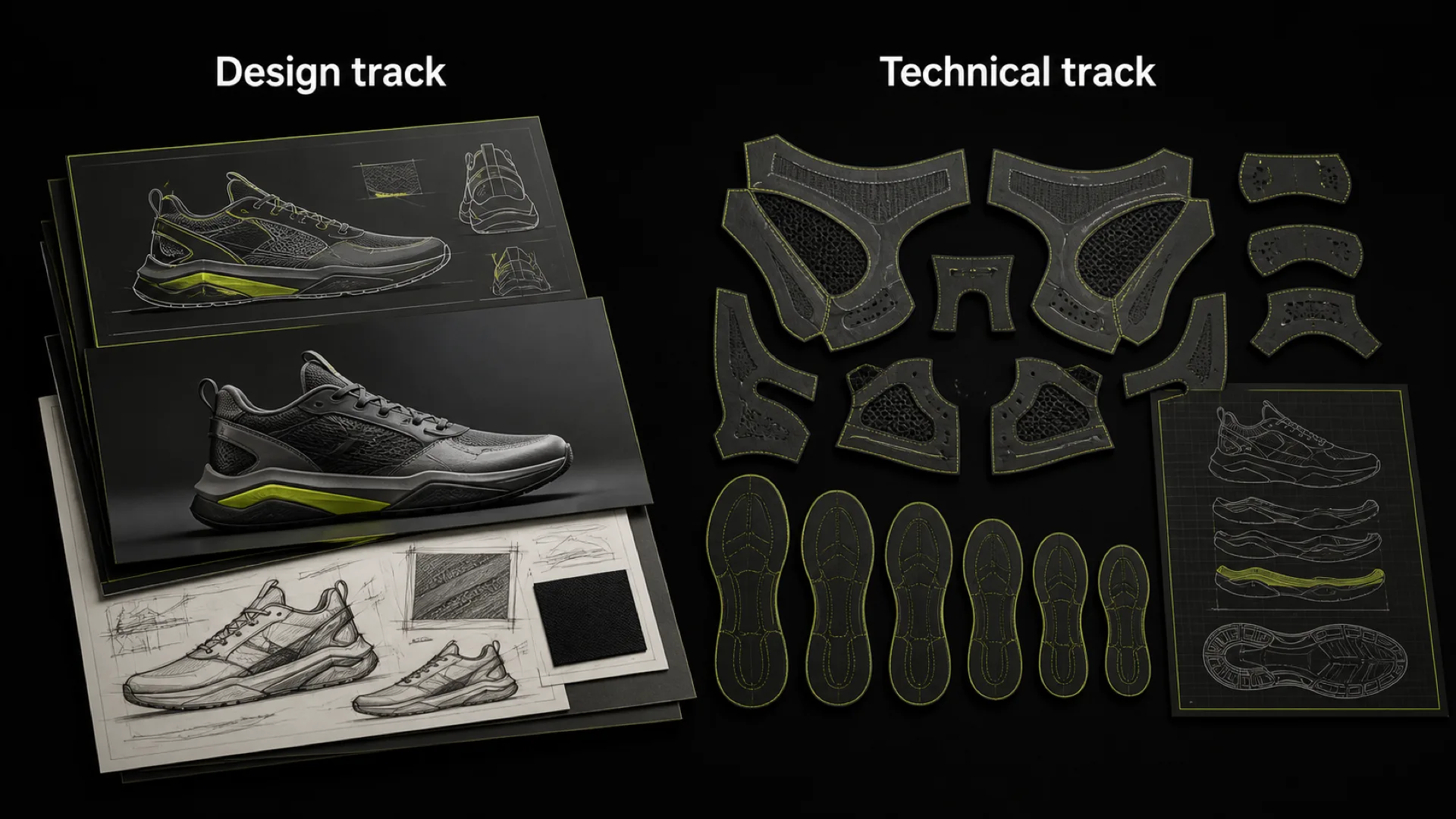
Ask this before anything else: what will I be able to produce on the last day of this course?
The answers cluster into two kinds, and they lead to different careers.
"A portfolio of designs." Concepts, boards, renders, a coherent point of view. This is the design track — brand-side, product, creative direction. Valuable, and what degree programmes are built to deliver.
"A model developed on a last, flattened into a graded pattern, with a technical sheet." This is the technical track — pattern engineering, product development, technical office. It is the harder thing to teach and the rarer thing to find in a prospectus.
Neither is better. But a course that promises both in a few weeks is usually delivering the first and gesturing at the second, and it is worth knowing which one you are buying. If the technical track is what you want, the modelling and pattern side is where to check the syllabus depth.
Software: the Part Prospectuses Underplay
This is where courses diverge most and disclose least.
Footwear technical offices in Europe run vertical footwear CAD — Icad Universe (developed by INESCOP), Shoemaster, Romans CAD. These tools are organised around how a shoe is actually built: import the last, design the upper in 3D, flatten to a production pattern, grade across sizes, export for cutting.
General 3D software does not do that. Rhino is excellent for sole and heel geometry and is genuinely used in the industry, but it has no native last-based workflow and no production pattern output. Blender is a strong visualiser and free. CLO3D leads for textile sneaker uppers. All three are real professional tools — none of them replaces footwear CAD for pattern work. The full software comparison sets out what each one actually covers.
The practical consequence: if you want to work in a technical office, a course that teaches only generalist 3D leaves you needing to learn the vertical tool afterwards, on your own. Ask which software is taught, for how many hours, and whether a licence is included. A course that will not answer that directly has answered it.
What to Ask Before You Pay
- What do I produce by the end? A pattern and tech pack, or a portfolio? (See above — this is the one that matters most.)
- Which software, and for how many hours? Named tools, not "industry-standard CAD".
- Who teaches it, and are they still working in footwear? A tutor with current practice knows what factories are asking for now.
- How much time is hands-on? Ratio of practical work to lectures.
- Is a software licence included? Vertical footwear CAD is expensive; a course that includes access removes a real barrier.
- What happens if I fall behind? Fixed-schedule courses have a real failure mode for people with jobs.
- Can I see a graduate's final work? Not a showreel — one actual complete piece of work.
- What do graduates do now? Specific roles at specific kinds of company, not a percentage.
On "Recognised" and "Certified"
Footwear design has no licensing body. No qualification is legally required to work as a footwear designer or pattern engineer, and no authority accredits courses the way medicine or accountancy are accredited.
So "recognised certificate" means: recognised by whom? Three answers are meaningful — a university degree carries academic recognition; a certificate from a software vendor demonstrates verified competence in that tool; and a school with genuine industry standing carries weight through its graduates and its network. Anything else is a document.
What employers actually assess is what you can do. In technical roles that means a complete developed model; in design roles, a portfolio with a coherent point of view. The certificate helps you get the conversation; the work gets you the job.
FAQ
Do I need a degree to work in footwear design?
No. Footwear has no licensing requirement, and technical roles in particular hire on demonstrated skill. A degree helps for brand-side and creative positions, where the network and the credential open doors. For pattern engineering and product development, a technical diploma or a focused course plus a strong body of work is a faster and cheaper route to the same job.
How long does it take to learn footwear design?
To be productive on straightforward work: a few months of intensive practice. To handle a full collection with grading and industrialisation: years. The variable is not the course length but the practice volume. Digital tools shorten the early phase because they make construction logic visible and repeatable, but they do not shortcut experience of how materials behave when shaped.
Are online footwear design courses worth it?
They are, when they teach a complete workflow in professional software and end in finished work. They are not, when they are a set of disconnected tutorials in a hobbyist tool. The format is not the problem — footwear CAD teaches well on screen, since that is where the work happens. Assess the syllabus and the software, not the delivery method.
How much does a footwear design course cost?
A university degree runs to tens of thousands over three or four years. Technical diplomas typically cost thousands. Structured online professional courses generally sit in the high hundreds to low thousands. Short workshops are a few hundred. Compare against what you can produce at the end, and check whether a software licence is included, since that can be a significant separate cost.
What is the difference between a footwear design course and a shoemaking course?
A design course teaches you to conceive and specify shoes: design, patterns, tech packs, development. A shoemaking course teaches you to physically make them: cutting, closing, lasting, sole attachment, finishing. They are complementary — understanding making makes you a better designer, because most design errors are errors about what the making process will tolerate — but they lead to different work.
Should I learn Rhino or footwear-specific CAD first?
If your goal is structured footwear and a technical office role, start with vertical footwear CAD: you learn the industry's workflow logic from the beginning rather than building habits you then have to undo. If you already have Rhino fluency from product design, add footwear CAD as the second tool to complete the workflow. Rhino remains the stronger choice for sole and heel engineering either way.
Choosing, Practically
Work backwards from the job. If you want to design collections for a brand, weight the degree and the portfolio. If you want to develop products in a technical office — the roles that are genuinely hard to fill right now — weight construction, pattern engineering and the software the industry runs on, and worry less about the institution's name.
The career path into 3D footwear design sets out where each route leads, and how a shoe is designed shows the full sequence a technical course should cover.
I'm Susanna Zampieri — 3D footwear designer, official Icad Universe trainer and iCad Brand Ambassador, and I built 3DFootwear Academy's course as the online technical option I could not find when I was starting: the complete Icad Universe workflow from last import to graded pattern to render, with a licence included, at your own pace. If it is not the right fit for you, the questions above still are — use them on whoever you talk to next.