What Is a Shoe Last? The Hidden Foundation of Every Shoe
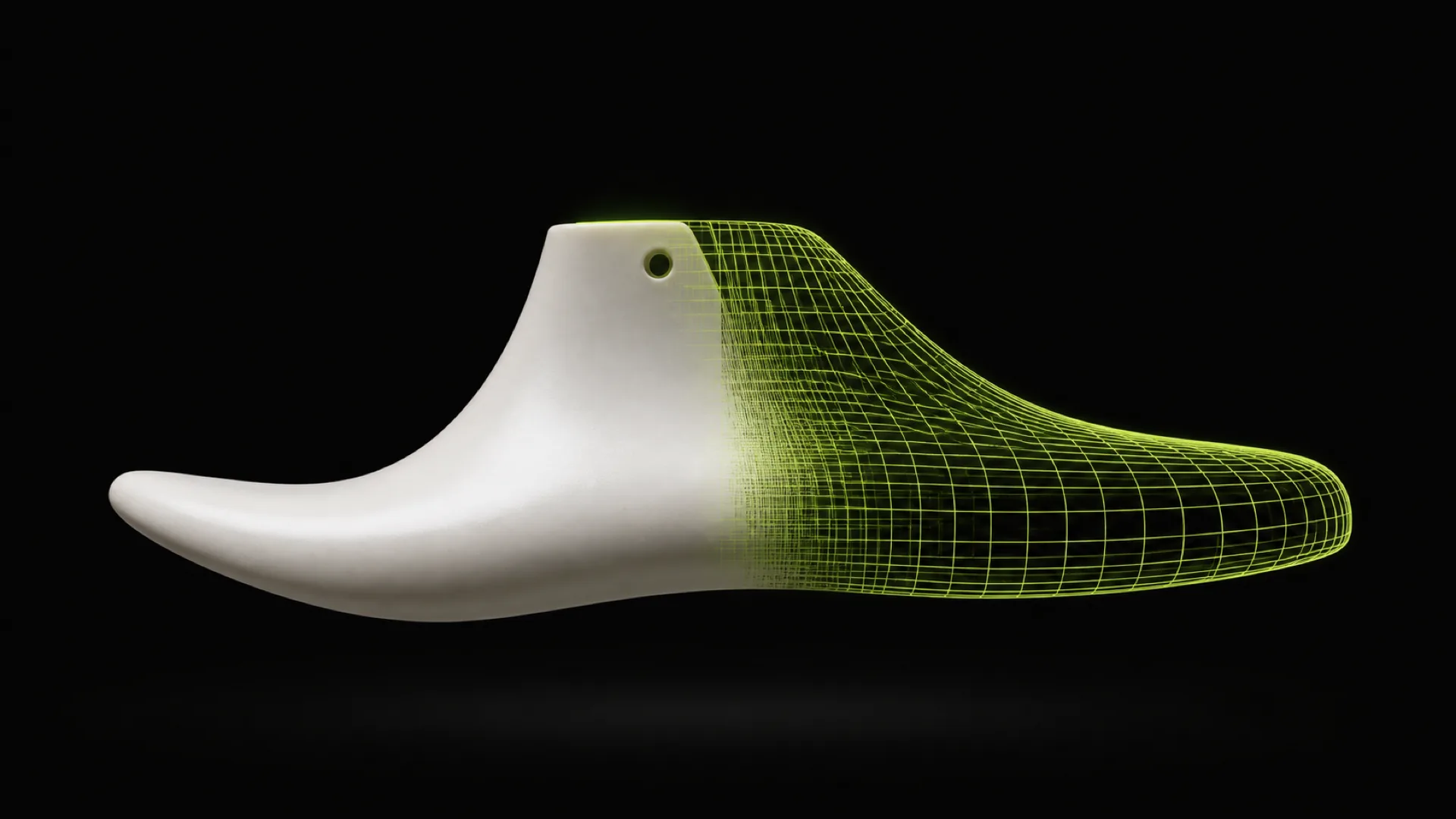
Every shoe you have ever worn was built around an object you have probably never seen. Before the leather, before the pattern, before the design: the last. Get it wrong and no amount of craftsmanship downstream will save the shoe — it will look correct and feel wrong.
Key Takeaways
- A shoe last is the three-dimensional form that a shoe is constructed around. It determines fit, volume and silhouette.
- The last is not a copy of a foot. It is a deliberate distortion of one, built to account for how a foot behaves in motion and how materials stretch.
- Last anatomy has its own vocabulary — cone, waist, featherline, heel seat, toe spring — and pattern work depends on it.
- Lasts are classified by material (wood, plastic, resin), by construction (solid, hinged, split), and by shape family.
- In industrial footwear the last is now a digital object: a 3D file that drives pattern engineering, grading and production output.
What Is a Shoe Last?
A shoe last is the three-dimensional form — traditionally wood, today usually high-density plastic — that a shoe is constructed around. It defines the internal volume of the finished shoe, and therefore its fit, its silhouette, and the shape of every pattern piece that wraps it.
The word is unrelated to "last" meaning final. It comes from the Old English lāst, meaning footprint or trace.
Here is the part that surprises most people learning footwear: a last is not a model of a foot. It is intentionally different from one. A foot spreads under load, lengthens as it rolls through a step, and swells over the course of a day. Leather stretches in some directions and not others. A last is built to absorb all of that — it is narrower than the foot at the waist, longer at the toe, and shaped to hold a form the foot will settle into rather than to match the foot at rest.
That distinction is why last-making is a discipline in its own right, and why a shoe built on a beautiful last with a mediocre pattern still fits better than the reverse.
Why the Last Determines Everything Else
In footwear development the last is the first decision and the constraint every later decision inherits.
Fit lives in the last. Length, width, instep girth, heel volume and toe box height are all last properties. A designer cannot fix a fit problem by changing the upper; the fit was decided before the upper existed.
Silhouette lives in the last. A square toe, an elongated almond, a chisel — these are last shapes, not pattern shapes. Two shoes with identical patterns on different lasts read as different products.
The pattern is derived from the last. The upper is designed on the last's surface and then flattened into cuttable pieces. Change the last and every piece changes with it. This is why factories treat a last change mid-development as a serious event rather than a tweak.
Heel height is built into the last. The last carries the pitch. You cannot raise a heel by adding to the sole unit without a last built for that height, because the whole foot geometry — toe spring, heel seat angle, weight distribution — shifts with it.
The Anatomy of a Shoe Last
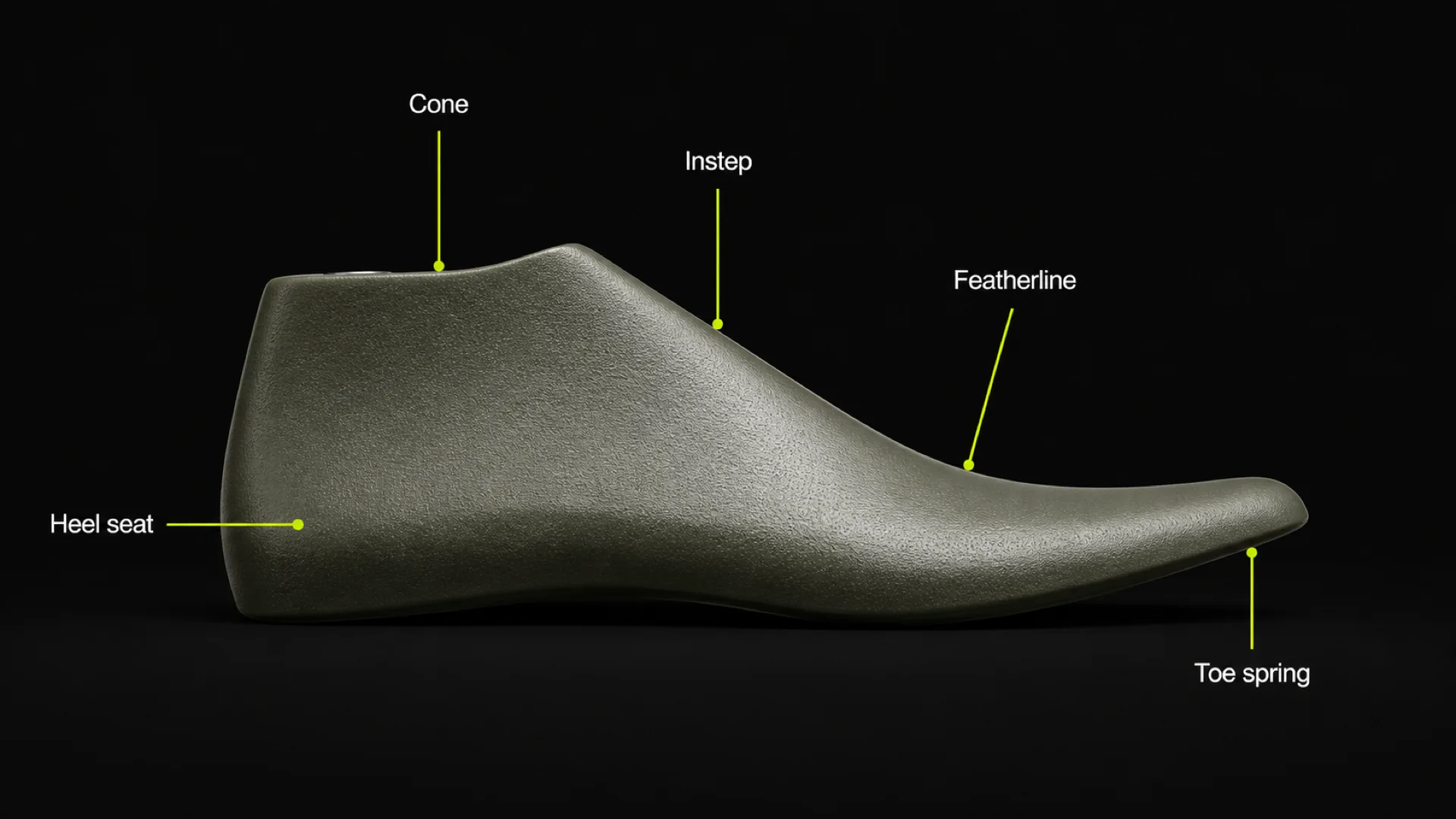
Last vocabulary is specific, and pattern work is impossible without it. These are the terms that come up daily.
- Cone — the top rear section, the part that corresponds to the ankle opening. Its shape controls how the shoe grips the foot.
- Instep / waist — the arch region. The girth measurement here is one of the strongest fit determinants.
- Featherline (feather edge) — the line where the last's bottom meets its sides. It is the boundary the upper is lasted over and the reference edge for the sole.
- Heel seat — the bottom rear surface where the heel of the foot sits.
- Toe spring — the upward curve at the front of the bottom. It lets the shoe roll through a step instead of hinging.
- Bottom (sole plane) — the underside surface the insole and outsole are matched to.
- Back curve — the rear profile from cone to heel seat, which controls heel hold.
- Recede / toe shape — the front-end geometry that gives the shoe its visual character.
If these terms are new, the footwear design glossary collects them with the rest of the vocabulary you will meet in the first months.
Types of Shoe Last
Lasts are classified along three independent axes, and any given last has a value on each.
By material
Wood — beech and maple, traditional and still standard for bespoke and orthopaedic work. Wood can be built up with leather shims and rasped down, which is exactly what custom fitting requires. It is dimensionally sensitive to humidity and comparatively expensive.
High-density plastic (HDPE, polyethylene) — the industrial standard. Dimensionally stable, cheap to reproduce in volume, machinable, and tough enough to survive repeated lasting cycles. Nearly all factory production runs on plastic lasts.
Resin and 3D-printed — used for prototyping and short runs. Additive manufacturing has made one-off lasts economically viable, which changed how sampling works: a new last shape can exist physically within a day of being modelled.
By construction
Solid — one piece, simplest and most rigid. Used where the shoe opening is wide enough to pull the last back out.
Hinged — a metal hinge lets the last collapse so it can be removed from a closed shoe. Standard for boots and high-cut styles.
Split / scoop-back — a wedge section removes to reduce volume for extraction. Common in bespoke work.
Two-part (removable heel block) — used for high-heel and complex constructions where the pitch prevents straight withdrawal.
By shape family
Shape families are how brands organise their last libraries: round toe, almond, chisel, square, pointed, and so on. Within each family a brand maintains its own proportions, and those proportions are part of its identity. A house last is genuine intellectual property — it is the reason a brand's shoes are recognisable across seasons and why last libraries are guarded.
How Shoe Lasts Are Made
The traditional route. A last maker starts from foot measurements or an existing last and works a wooden blank by hand and on a lathe, checking girths against a tape and refining by eye and feel. Copies are cut on a last-turning lathe that traces a master. It is a craft skill with a long apprenticeship, and there are far fewer people doing it than there were fifty years ago.
The industrial route. A master last is modelled or scanned, then reproduced by CNC machining from plastic blanks. Grading across the size range is computed rather than carved. This is what makes it feasible to produce one shape in thirty sizes and multiple widths.
The digital route. The last is created or modified as a 3D model, validated on screen, and either machined, 3D-printed, or used purely as a digital object for pattern development. This is now the dominant workflow in industrial footwear, and it is the part almost no introductory article on lasts covers.
The Digital Last: How Industrial Footwear Actually Works Now
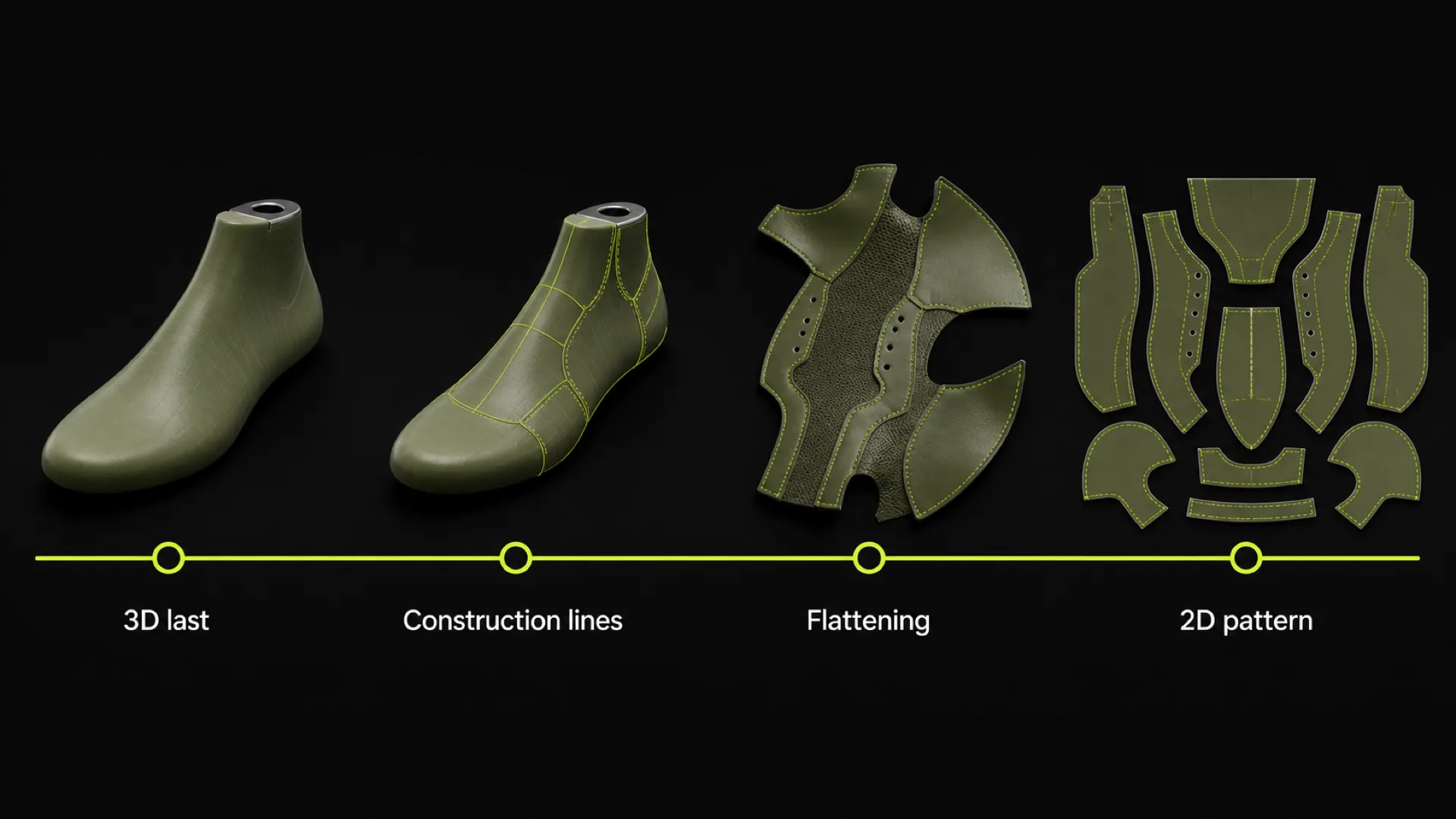
Most explanations of the shoe last stop at the wooden object, because most of them are written from a hand-shoemaking perspective. That leaves out how the majority of the world's footwear is currently developed.
In a modern technical office the last arrives as a 3D file — scanned from a physical master, supplied by a last manufacturer, or modelled from scratch. From that point the last is a working surface rather than a physical thing:
- The upper is designed directly on the digital last. Construction lines, seam positions and panel boundaries are drawn onto its surface in three dimensions. The upper modelling workflow begins here.
- The pattern is flattened from it automatically. Footwear-specialised CAD unwraps the 3D surface into flat, cuttable pieces while respecting lasting allowance, grain direction and seam placement. This 3D-to-2D flattening is the step that makes the whole approach work.
- Grading is computed from the last's size progression, rather than scaled proportionally — which matters, because feet do not scale linearly.
- The same model carries through to presentation. The geometry used for pattern engineering is the geometry used for the photorealistic render shown to a buyer.
The tools that do this are vertical footwear CAD systems built around last-based logic — Icad Universe (developed by INESCOP, with 1,700+ installations across 39 countries), Shoemaster, Romans CAD. Generalist 3D software can model a last shape, but none of them natively understands lasting allowance or produces a production pattern from it; the software comparison sets out where each tool actually fits.
The practical consequence for anyone entering footwear: understanding the last is no longer separate from understanding the software. The last is where the two meet. Learning to read a last — where its volume sits, how its featherline runs, what its toe spring is doing — is what makes the digital tools produce shoes that fit rather than shapes that render well. Working the other way round, from the software toward the craft, is the most common way people get stuck.
Our own 3D last modelling walkthrough covers the mechanics of working with a last inside a footwear CAD environment.
Shoe Last Sizing and Grading
A last exists in a base size — commonly UK 8 / EU 42 for men's, UK 5 / EU 38 for women's — and the rest of the size run is graded from it.
Grading is not uniform scaling. Length, width and girth progress at different rates, because human feet do not get proportionally wider as they get longer. Standard practice moves length in fixed increments (a UK half size is 1/12 inch, roughly 4.2 mm) while girth follows its own progression, and width fittings (D, E, EE and so on) are separate series at the same lengths.
This is also why last sizing does not map cleanly between systems. UK, US and EU scales use different zero points and different increments, and a brand's own fit sits on top of all of it. Two shoes marked EU 42 on different house lasts can differ by several millimetres of internal length.
FAQ
What is a shoe last used for?
A shoe last is used as the form a shoe is built around. The upper is shaped and stretched over it during lasting, the pattern is derived from its surface, and the sole is matched to its bottom. It sets the shoe's internal volume and therefore its fit, and it defines the silhouette. In development it is also the reference object for grading the design across sizes.
Is a shoe last the same shape as a foot?
No, and deliberately so. A last accounts for how a foot behaves rather than how it looks at rest: feet spread under load, lengthen through a step, and swell during the day, while leather stretches unevenly. A last is typically closer-fitting than the foot at the waist and longer at the toe, shaped to hold a form the foot settles into. Matching a foot exactly would produce a shoe that fits badly in motion.
What are shoe lasts made of?
Traditionally beech or maple wood, still standard for bespoke and orthopaedic work because wood can be built up and rasped down for custom fitting. Industrial production uses high-density plastic (typically HDPE), which is dimensionally stable, cheap to reproduce and machinable. Resin and 3D-printed lasts are used for prototyping and short runs.
What is the difference between a shoe last and a shoe mould?
A last is the positive form the shoe is built around; the shoe wraps its exterior. A mould is a negative cavity that material is injected or pressed into, used to produce components such as outsoles and midsoles. A single shoe involves both: it is constructed on a last, and its sole unit comes out of a mould.
Can you make shoes without a last?
Some soft, unstructured footwear — simple moccasins, certain sandals, huaraches — can be made with minimal or no last. Anything with a defined shape, a heel, or a structured toe requires one, because the form has to be held while the upper is shaped and the sole attached. Without a last there is no reliable way to reproduce fit across pairs or across sizes.
How do I choose a shoe last size?
Match the last's internal length and girth to the intended foot measurements plus the allowance appropriate for the construction and material. Length allowance is typically a small margin ahead of the longest toe; girth is the more critical measurement and the more common source of fit failure. Because brand lasts differ, a last's nominal size is a starting point rather than a specification — the measurements are what matter.
Where the Last Fits in a Footwear Career
The last is the first thing a footwear technician learns and the thing experienced ones keep returning to. It sits underneath every other skill: pattern engineering, grading, fit correction, even material selection are all downstream of decisions the last already made.
If you are moving into footwear development, the practical order is to learn to read a last, then learn to build a pattern on it, then learn the software that connects the two. That is the sequence a technical office works in, and the career path into 3D footwear design follows it.
I'm Susanna Zampieri — 3D footwear designer, official Icad Universe trainer and iCad Brand Ambassador. The 3D Footwear Design course starts from the last for exactly this reason: it is where the shoe starts, so it is where the workflow has to start too.