Types of Heels: Names, Heights and How Each One Is Designed
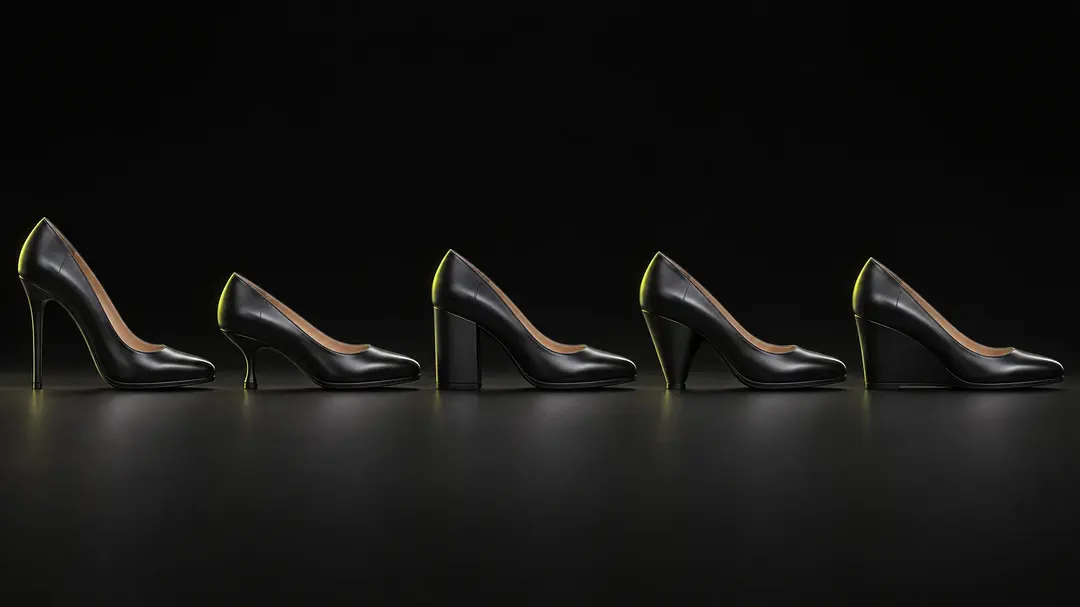
Most guides to the types of heels are written for shoppers: which heel looks right with a dress, which one hurts less by the end of the night. That is useful, but it skips the question a designer asks first. What defines a heel, and what makes it hold up under a person's weight?
This guide covers the common heel types with their names, typical heights and where people wear them. Then it covers what style guides rarely explain: the parts of a heel, heel pitch, how the heel is fixed to the last and the shoe, and how heel geometry is modelled in 3D. It is written from the pattern-making and design side, not from the shop window.
Key Takeaways
- A heel is the part of the shoe's bottom unit that raises the back of the foot. Its shape and height set the shoe's character and comfort.
- Heel types are grouped by silhouette: stiletto, kitten, block, cone, wedge, platform, Louis, Cuban, stacked, spool and flare, among others.
- The heel is never chosen separately from the last. The last is built for one specific heel height, and that pitch drives the whole shoe.
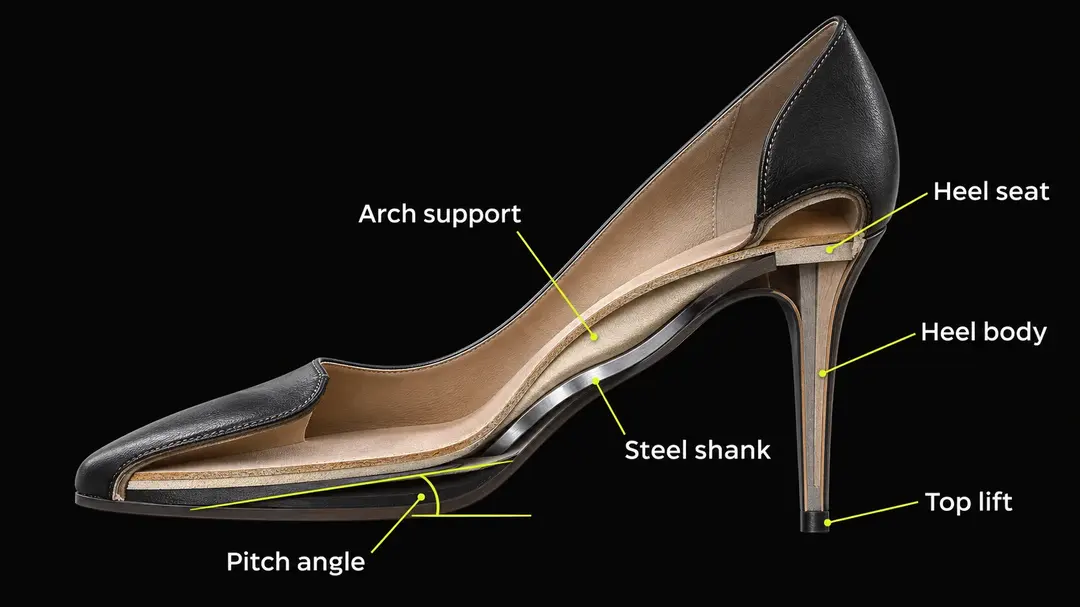
- A heel has a top lift, a body, a seat and, inside the shoe, a steel shank that supports the arch.
- 3D modelling lets a designer test heel height, pitch and shape before a single prototype is made.
What Is a Heel?
A heel is the part of a shoe's bottom unit placed under the back of the foot that raises the heel above the ball of the foot, and whose height, shape and position set the wearer's posture, balance and the shoe's style. It is attached to the sole and to the shoe's construction, and it always works together with the last the shoe is built on.
A heel is not decoration: it carries body weight on every step, so it is a structural part. Designing one means weighing silhouette, material, how it joins the shoe and the angle it holds the foot at, all at once. To see where it sits in the whole shoe, read the parts of a shoe, and for the heel-specific components see parts of a high heel shoe.
What Are the Most Common Types of Heels?
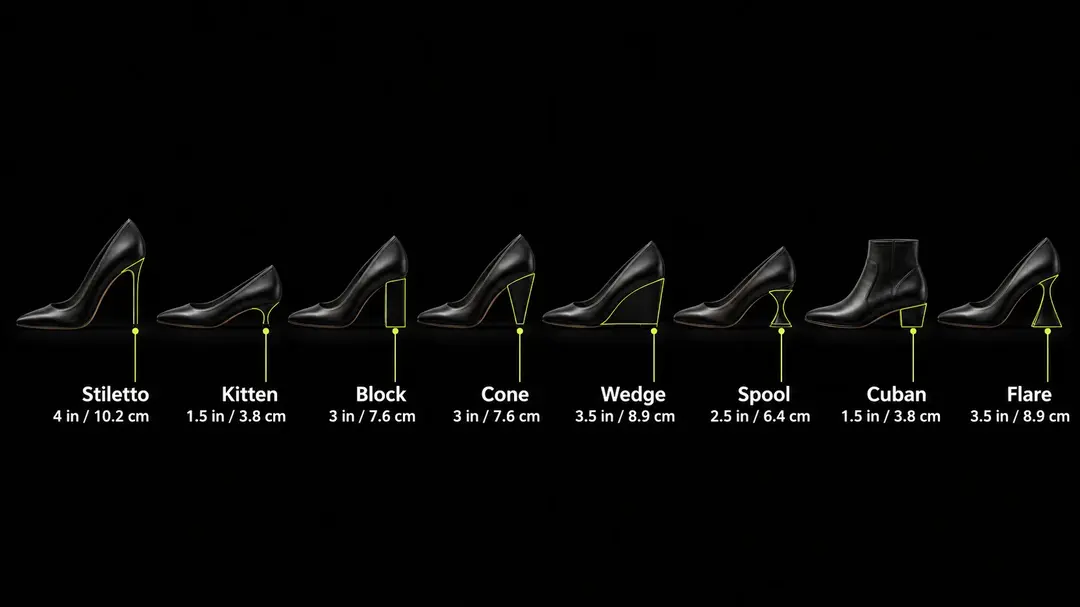
Heel types are classified mainly by silhouette (how the heel looks from the side and the front) and by height. Each name describes a specific shape, though brands and regions disagree on exact height limits.
The heights below are typical ranges, not rules. No standard defines when a heel stops being "mid" and becomes "high"; every brand and collection uses its own bands.
Heel types chart: names, heights and where to wear them
| Heel type | Typical height | Shape | Where to wear it |
|---|---|---|---|
| Stiletto | 3 to 5 in (8 to 12 cm) or more | Very thin, near vertical | Evening, formal events, classic pumps |
| Kitten | 1.2 to 2 in (3 to 5 cm) | Slim and short | Office, long days |
| Block (chunky) | 1.5 to 3 in (4 to 8 cm) | Thick, straight sides | Everyday, sandals, ankle boots |
| Cone | 2 to 3.5 in (5 to 9 cm) | Wide at the top, tapering to a small tip | Modern pumps, ankle boots |
| Wedge | 1.2 to 4.7 in (3 to 12 cm) | One solid piece from heel to forefoot | Summer, espadrilles, sandals |
| Platform | 0.8 to 2.4 in (2 to 6 cm) front lift | Raised under the ball of the foot too | Fashion, party |
| Louis (Louis XV) | 1.5 to 2.8 in (4 to 7 cm) | S-shaped curve, small base | Classic, bridal, vintage |
| Cuban | 1.2 to 2.4 in (3 to 6 cm) | Straight, broad base, slanted front | Boots, western, men's styles |
| Stacked | 1 to 3 in (3 to 8 cm) | Layers of leather pressed and cut | Men's dress shoes, boots, loafers |
| Spool (cotton reel) | 1.5 to 3 in (4 to 8 cm) | Narrow in the middle, wider at both ends | Retro pumps, sandals |
| Flare | 2 to 3.5 in (5 to 9 cm) | Narrow under the foot, widening toward the floor | 1970s revival boots, sandals |
| Sculptural | Variable | Free form, close to an art object | Designer collections, runway |
Thin heels: stiletto, kitten and Louis
The stiletto heel is the best known and the most technically demanding, because a very small section carries the whole load. Stilettos normally have a steel reinforcement inside so they do not snap. The kitten heel is the short version for people who want the line without the steep angle. The Louis heel, with its S-curve, is named after the French court fashion of the 18th century and still appears in classic and bridal shoes.
Wide heels: block, Cuban, stacked and cone
A wider base means a more stable heel. Block heels are the everyday workhorse. The Cuban, with its slanted front face, belongs to boots and ankle boots. The stacked heel is built from layers of leather or leather-board and is the traditional heel of men's dress shoes. The cone is wider at the top and tapers down, which looks light while keeping medium stability.
Design heels: spool, flare and sculptural
These are the heels that play with form. The spool narrows in the middle like a cotton reel. The flare widens toward the floor. The sculptural heel leaves classical geometry behind. They benefit most from being seen in 3D, because an unusual silhouette rarely reads well on a flat sketch.
Wedge and platform: lift without a separate heel
A wedge is one continuous piece from the heel to the front, and a platform raises the forefoot as well. In both cases the difference between heel and forefoot is smaller than on a stiletto of the same total height. That is why they often feel more comfortable than their numbers suggest.
For the wider catalogue of footwear families, see the types of shoes guide, and for boots with heels specifically, types of boots.
What Are the Parts of a Heel?
A heel has four main zones: the top lift that touches the ground, the body that gives the silhouette, the seat that joins it to the shoe and, inside, the metal shank. Knowing these parts is what lets a designer specify a heel precisely on a pattern or a tech pack.
Top lift (tip)
This is the piece that hits the floor and wears down. It is usually hard plastic, rubber or polyurethane, and on quality shoes it can be replaced. On a stiletto it is tiny, and its diameter directly affects stability.
Heel body
The visible part that defines the type: thin, thick, curved, flared. It has a front face (toward the toe) and a back, and the two usually have different profiles. When I model a heel, the back profile is the first thing I fix, because it sets the final height.
Heel seat
The seat is the top surface of the heel, where the sole or insole rests. It must match the shape of the last's heel. If it does not meet the bottom unit properly, the shoe sits crooked, and that is expensive to fix in production.
Shank
The shank is the rigid piece, usually steel or composite, placed between the insole and the outsole under the arch. It supports the bridge of the foot and stops the shoe collapsing in the middle, which matters a lot when the heel is high.
How Does Heel Height Relate to the Last?
The heel is never chosen separately: the last is built for a specific heel height, and the rise of the back of the foot (the pitch) defines the foot's posture inside the shoe. Changing the height without rebuilding the last usually gives a shoe that does not fit.
This surprises people who are starting out. A last for a 0.8 in (2 cm) heel and one for a 4 in (10 cm) heel look very different. The second has a much higher heel relative to the toe, a steeper instep and a forefoot resting at another angle. You cannot take a flat last and "raise" the heel.
What heel pitch is
Pitch is the tilt of the last, meaning how far the heel rises above the plane the forefoot rests on. A higher heel means a bigger pitch. That tilt is set before the upper is drawn, because patterns are developed on the surface of that specific last. What is a shoe last explains how lasts are built.
How the heel is fixed to the last and the shoe
In production, the shoe is lasted over the last with the heel seat shaped to receive the heel. The heel is then attached to the bottom unit, usually with adhesive plus nails or screws through the seat, and the shank is placed beforehand. Because the seat must meet the heel exactly, heel seat geometry on the last and the heel itself have to be designed together. The steps of the process are in shoe lasting.
Why this matters in the studio
In the studio, the sequence is always the same: decide the heel height first, build the last with that pitch, and only then design the upper and bottom unit. Changing the heel mid-project means rebuilding the last and, with it, the pattern.
Height and comfort
Comfort does not depend only on inches. Pitch, the position of the heel under the foot, the width of its base and the arch support all matter, and load on the forefoot grows as the heel rises. To see how the upper develops on that last, read about shoe pattern making.
What Are Heels Made Of?
Heels are made mainly from injection-moulded ABS plastic, wood or stacked leather, with a steel reinforcement inside the thin ones. The choice depends on silhouette, cost, weight and how much load the part has to take.
Injection-moulded ABS
The most common material in industrial heels. ABS is injected into a mould, which allows large runs with accurate shapes, then wrapped in leather or painted. It is light and repeatable; the limit is mould cost, which only pays off with volume.
Wood
Used for wide heels, wedges and craft-style footwear. It is stable and looks warm, but it needs machining and is usually heavier than plastic. Wedges often combine it with cork or jute.
Stacked leather
A stacked heel is built by layering leather or similar material, pressing the layers and cutting them to shape. It is the classic system for men's dress shoes and Cuban heels. It is strong and repairable, though the silhouette is limited to what stacking allows.
Steel inside the stiletto
The stiletto has a steel rod running through the body to prevent breakage in such a thin section. It sits inside the heel, so you never see it. For technical standards on footwear components, SATRA is a good starting point.
How Is a Heel Designed and Modelled in 3D?
A heel is designed in 3D by building its profile on the last, adjusting height and tilt, modelling the body and checking that the seat fits the bottom unit. The digital method lets you iterate silhouette quickly and catch fit problems before the first prototype.
Step 1: Start from the last
Everything starts with the right last for the chosen height. The heel is modelled against it, so heel angle and pitch are already defined. In Icad Universe, the footwear CAD developed in Elche, Spain by INESCOP, last, heel and bottom unit are modelled in the same environment, which avoids transfer errors between programs.
Step 2: Define the profile and silhouette
Draw the side and front profile: total height, thickness at the seat, diameter at the top lift, curvature. A stiletto, a spool and a Louis are told apart by these curves, and a millimetre can change the character. In my workflow I review the profile from three views before turning it into a solid.
Step 3: Model the solid and the seat
With the profile set, the volume is generated and the seat surface is adjusted to match the last's heel and the bottom unit. This is a common source of fit problems in first prototypes, and checking it on screen saves physical samples.
Step 4: Check against the bottom unit and prepare for production
The heel is reviewed together with the sole, the shank and the lasting insole, then exported for moulding, machining or a 3D-printed prototype. The 3D sole and heel design guide covers this flow in detail.
What Mistakes Do Designers Make with Heels?
The most frequent errors are fixing the height too late, ignoring the last's pitch, underestimating the load on a thin heel and not checking seat fit. Most are caught early if the sequence is right.
- Choosing the heel last. Height drives the last; deciding late means redoing work.
- Reusing a last from another height. A flat last will not work for a high heel.
- A stiletto with no steel rod or shank. A thin section without reinforcement breaks, or the shoe sags at the arch.
- A seat that does not match the bottom unit. It produces crooked shoes and heels that come loose.
FAQ
What is the most comfortable type of heel?
Wide and mid-height heels such as the block, the stacked heel or the kitten tend to be the most comfortable because they spread weight better. Comfort also depends on the last, the pitch and the arch support, not only on height in inches.
What is the difference between a stiletto and a kitten heel?
A stiletto is very thin, near vertical and usually has a steel rod inside, with a height of about 3 in (8 cm) or more. A kitten heel is a slim heel kept short, typically 1.2 to 2 in (3 to 5 cm), so it gives the same line with less tilt.
Can you change the heel height of a shoe?
A cobbler can sometimes change it slightly, but not by much, because the last and the arch support are built for that height. In design, changing the height means rebuilding the last and the pattern, not just swapping the part.
What are heels made of?
The main materials are injection-moulded ABS, wood, stacked leather and, inside thin heels, a steel rod. Each is chosen for silhouette, weight, cost and production volume.
What is a shank in a heeled shoe?
A shank is a rigid steel or composite piece placed under the arch between the insole and the outsole. It supports the bridge of the foot and keeps the shoe from sagging, which is especially important with high heels.
From Heel Types to Designing Heels
A heel is easier to understand as part of a system: last, upper, bottom unit and reinforcements working together. If you want to learn to design and model one, start with the 3D sole and heel design guide and what is a shoe last.
This article is by Susanna Zampieri, a 3D footwear designer with more than ten years of experience, direct Brand Ambassador of iCad and official trainer of Icad Universe, the footwear CAD developed by INESCOP in Elche. For a full path with real practice, the 3D footwear design course covers everything from the last to the bottom unit and the heel.