Types of Boots: A Footwear Designer's Guide to Styles, Shafts and Construction
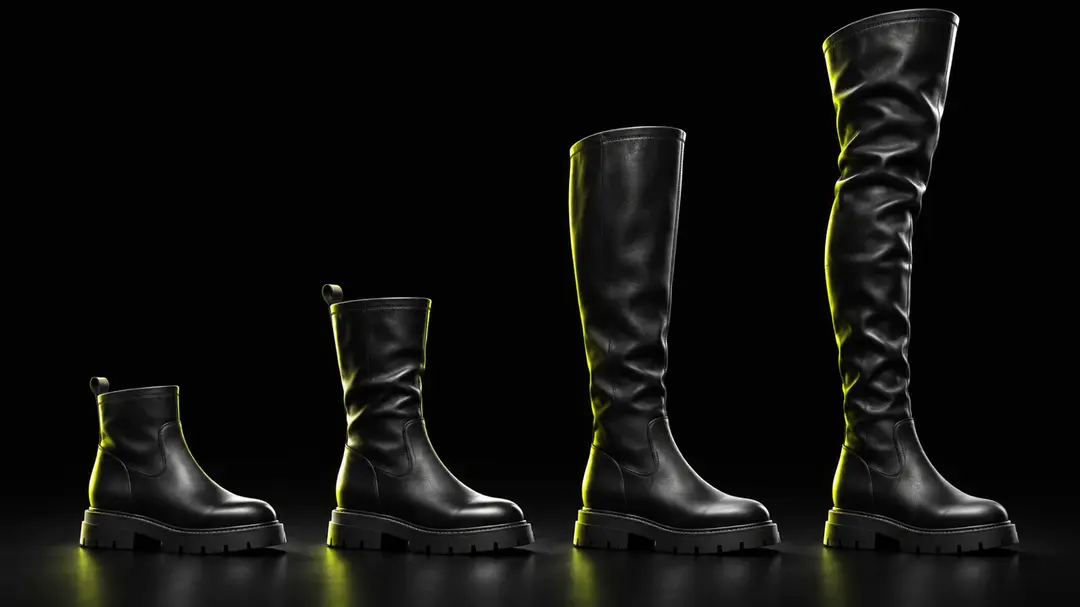
Most guides to the types of boots are written for shoppers: which pair goes with jeans, which one suits a dress. That is useful, but a boot has a very different logic for the person who has to draw it. A Chelsea boot and a cowboy boot are not just two looks. They are two different answers to the same problems: how high the shaft goes, how the foot gets in, and how the whole thing is built.
In the studio, I never start from the name of a style. I start from three decisions: shaft height, closure and construction. Once those are fixed, the named style (chukka, combat, engineer, western) mostly follows. This guide uses that same order, then gives you a table of 20 styles with what each one changes in the pattern and the last.
Key Takeaways
- A boot is footwear whose upper covers the ankle; everything else (mid-calf, knee-high, over-the-knee) is a matter of shaft height.
- Designers classify boots on three axes: shaft height, closure (pull-on, lace-up, zip, buckle) and construction (welted, cemented, moulded, stitched).
- The shaft is a separate pattern problem from the foot: calf and ankle girth, not the last, decide whether a tall boot fits.
- Closure drives the opening geometry: a pull-on needs elastic or a generous throat, a zip needs a stable, reinforced placket.
- Named styles such as Chelsea, chukka, western or Wellington are combinations of these three choices, plus a typical heel and toe shape.
What Are the Types of Boots?
The types of boots are the families of footwear whose upper rises above the ankle bone, grouped by shaft height (ankle, mid-calf, knee-high, over-the-knee), by closure (pull-on, lace-up, zip, buckle) and by construction (welted, cemented, stitched, moulded). Named styles such as Chelsea, chukka, combat or western boots are recurring combinations of those three choices.
Retail sites sort boots by occasion: work, hiking, fashion, winter. A designer sorts them by structure, because structure is what determines the pattern, the last and the cost. The two systems describe the same boots from different ends.
For a general reference on the category, see the Wikipedia entry on boots. For the vocabulary of the pieces themselves, the parts of a shoe guide has a section dedicated to the parts of a boot.
How Are Boots Classified by Shaft Height?
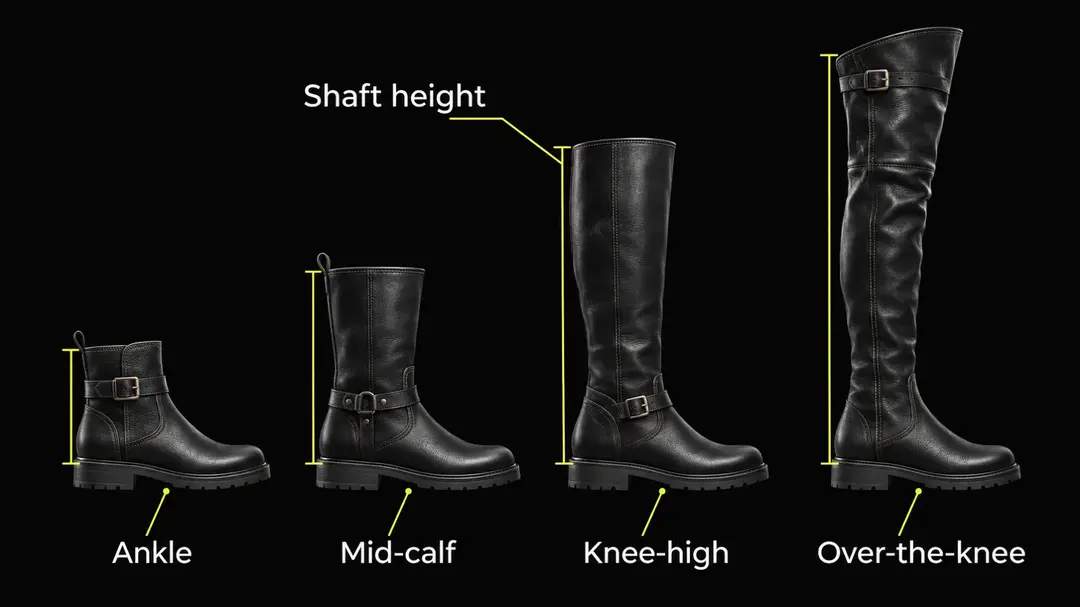
Shaft height is the distance from the heel seat to the top line of the boot, and it is the first axis designers use because it changes the pattern more than any other choice. Four bands cover almost every boot.
Ankle boots
Ankle boots (also called booties) stop at or just above the ankle bone, roughly 10 to 15 cm above the heel seat. The shaft is short, so the pattern stays close to a shoe pattern. The main concern is the ankle opening: it must clear the heel and the instep when the foot goes in, yet hug the ankle when it is on.
Mid-calf boots
Mid-calf boots reach the widest part of the lower leg. Here the shaft stops being a small extension of the shoe and becomes its own piece with its own measurements. Calf girth varies far more between people than foot size does, which is why this band is where fit complaints begin.
Knee-high boots
Knee-high boots end just below the knee. The shaft must be shaped to follow the leg's taper from the ankle to the calf and back in again below the knee. A flat, straight shaft gaps at the ankle and pinches at the calf.
Over-the-knee boots
Over-the-knee boots cover the knee. The shaft now has to stay up without a closure that grips, so designers rely on stretch material, a grippy lining or elastic panels. Bending the knee pulls on the top line, which is why the back is often cut lower or the shaft is made of stretch fabric.
What Closures Do Boots Use?
Boots use four main closures: pull-on (with elastic gores or pull tabs), lace-up, zip and buckle or strap. Each one dictates how wide the opening must be, where stress concentrates and which reinforcement the pattern needs.
Pull-on and elastic gore
A pull-on boot has no closure to adjust, so the foot has to pass through the opening and the boot has to hold on afterwards. A Chelsea boot solves this with elastic side gores, a pull-on boot like a Western with a snug throat and pull straps. The elastic gore sits at the side of the ankle, where the opening has to stretch to let the foot through, and needs a backing so it does not tear.
Lace-up
Lace-up boots adjust to the foot, so the pattern can be cut tighter and the lacing absorbs variation in instep height. The designer places eyelets or hooks, chooses the throat shape (open or closed, derby or oxford style) and reinforces the lacing area with a stay or a facing so the eyelets do not tear out.
Zip
A zip lets a close-fitting shaft open wide enough for the foot. A side or inside zip is common on fashion boots. The zip needs a stable placket, a protective flap behind it and a pull-tab that clears the top line. A zip is rarely a standalone fix: it usually pairs with a tighter calf cut that the closure makes wearable.
Buckle and strap
Buckles and straps either decorate (harness, engineer, monk styles) or really adjust the opening. When they are structural, the strap and its anchor point have to be stitched through enough layers to carry load. That is a construction decision, not just a styling one.
How Are Boots Constructed?
Boot construction is how the upper is attached to the sole. The main routes are Goodyear welting (stitched through a welt for resoleable work boots), cementing (glued, the standard for fashion boots), stitched constructions such as Blake and Norwegian welts, and moulded or vulcanized bonding for rubber boots.
Goodyear-welted boots
In a Goodyear-welted boot, a strip of leather (the welt) is stitched to a rib on the insole and to the upper, and the outsole is then stitched to the welt. It is durable and can be resoled several times, which is why work boots, engineer boots and many classic dress boots use it. The guide to shoe construction methods and the Goodyear welt entry on Wikipedia explain the process in more detail.
Cemented boots
A cemented boot has its sole glued directly to the lasted upper. It is lighter, more flexible and cheaper, and it allows thin profiles and complex outsole shapes. Most fashion boots, many hiking boots and almost all sneaker boots are cemented. The trade-off is that resoling is harder.
Stitched, Norwegian and Blake constructions
Blake and Blake/Rapid stitch the upper and outsole through to the insole, while the Norwegian uses a visible welt, for a close or water-resistant bond. Hiking and mountain boots often use stitched or Norwegian methods when a waterproof, repairable build matters.
Moulded and vulcanized boots
Rubber boots such as the Wellington and many snow boots are moulded or vulcanized: the upper and sole are formed or bonded under heat and pressure. The pattern is replaced by a mould, which changes the design process completely.
What Are the Main Boot Styles?
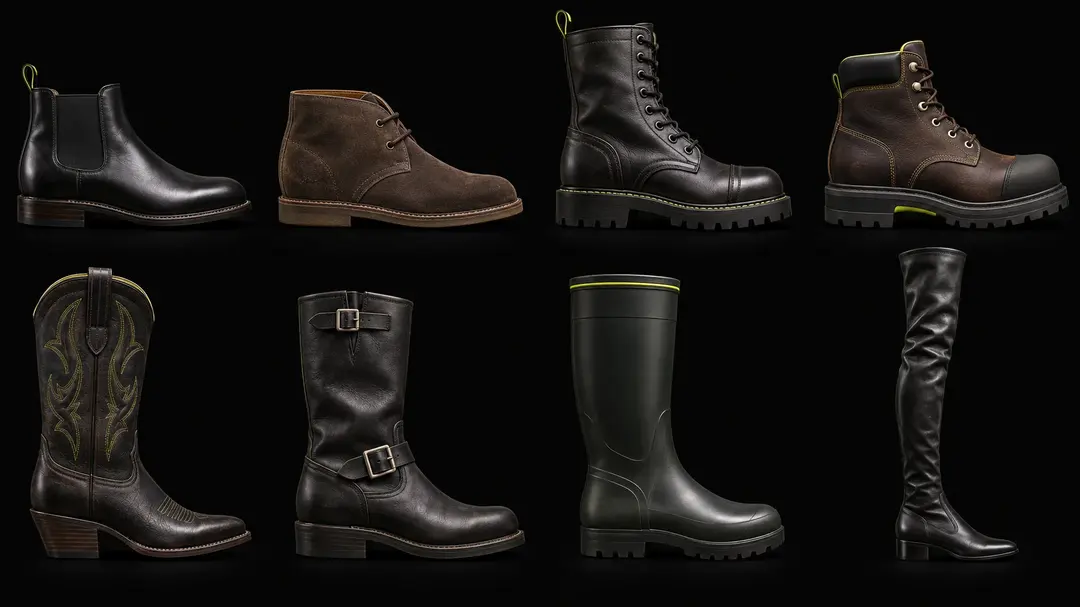
The main boot styles are Chelsea, chukka, desert, jodhpur, combat, work, hiking, western, engineer, harness, riding, Wellington, knee-high, over-the-knee, sock, shearling and several others. The table groups them by shaft, closure and construction, and shows the pattern or last issue each one raises.
| Style | Shaft | Closure | Typical construction | What changes in pattern / last |
|---|---|---|---|---|
| Chelsea | Ankle | Elastic gores | Goodyear or cemented | Gore placement and backing; throat must clear the instep |
| Chukka | Ankle | Lace-up (2-3 eyelet pairs) | Cemented or welted | Open derby throat; minimal shaft, close to a shoe pattern |
| Desert boot | Ankle | Lace-up | Cemented or stitched | Crepe sole, soft unstructured shaft, lighter last |
| Jodhpur | Ankle | Buckle strap | Welted | Strap anchor stitched through layers; clean, unbroken vamp |
| Combat | Ankle to mid-calf | Lace-up (often with zip) | Cemented or welted | Reinforced eyelet stay; padded top line; heavier sole |
| Work boot | Ankle to mid-calf | Lace-up | Goodyear welt | Wider fitting, toe cap reinforcement, safety toe space in the last |
| Hiking boot | Ankle to mid-calf | Lace-up with speed hooks | Cemented or stitched | Padded collar, flex zone at the ankle, wider toe box |
| Western / cowboy | Mid-calf | Pull-on | Welted (stitched) | Pull straps, high-arched shank, slanted heel, snug instep |
| Engineer | Mid-calf | Pull-on with buckle strap | Goodyear welt | Rounded top line, adjustable strap across the instep |
| Harness | Ankle to mid-calf | Pull-on with ring and strap | Goodyear welt | Strap through D-ring, high anchor point stitched through shaft |
| Riding | Knee-high | Pull-on or zip | Welted or cemented | Narrow calf, flat back stay, low heel for stirrup |
| Wellington | Mid-calf to knee | Pull-on | Moulded rubber (or leather) | Mould, not a pattern; shaft shape fixed by the tool |
| Knee-high | Knee | Zip or pull-on | Cemented | Calf grading, ankle-to-calf taper, stretch panel if tight |
| Over-the-knee | Above knee | Pull-on or stretch | Cemented | Stretch fabric or lining, high-grip top line |
| Sock boot | Ankle to mid-calf | Pull-on (knit) | Cemented or moulded | Knit shaft attached to a sole unit, no separate pattern shaft |
| Shearling (ugg-style) | Ankle to mid-calf | Pull-on | Cemented, stitched | Soft collapsed shaft, thick lining allowance, flat sole |
| Rain boot | Ankle to knee | Pull-on | Moulded | Shaft volume allowance, easy-on opening, anti-slip outsole |
| Moc-toe boot | Ankle to mid-calf | Lace-up | Goodyear welt | Moccasin vamp stitched on top, sizeable toe box |
| Snow / winter boot | Mid-calf | Lace-up or toggle | Cemented or moulded | Insulation thickness, waterproof gusset, big last volume |
| Paddock | Ankle | Lace-up or zip | Cemented | Short shaft, cleaner profile, rounded vamp |
How Does a Boot Differ from a Shoe in Pattern and Last?
A boot differs from a shoe in two ways: it has a shaft that must be fitted to the leg, and its opening has to let the foot pass through while the boot stays on. The last still controls the foot portion, but the shaft is shaped by calf and ankle measurements.
The last still shapes the foot
The foot part of a boot is built on a last, just like a shoe. The last decides toe shape, heel pitch, instep height and ball width. The shoe last explained in its own guide sets the volume that the vamp must wrap around. A boot last often has a slightly more generous instep than a shoe last, because the boot must slide on over the foot.
The shaft needs its own measurements
For anything above the ankle, the shaft is designed from the leg, not from the foot. Designers use the ankle circumference, the calf circumference at its widest and the height to the top line. These measurements do not scale with foot size in a clean way, so a tall boot often has several calf widths for each length.
Grading is different
When you grade a pattern up or down, the foot portion follows the last sizes, but the shaft does not scale the same way. Calf width is usually graded separately, or offered as regular, wide and extra-wide. Getting this wrong is the most common reason a boot looks right on the foot but fails on the leg.
How Do You Design a Boot in 3D?
In 3D footwear CAD, a boot starts with the last, then the shaft is modelled as a separate surface around the leg, and finally flattened into 2D pattern pieces. The key step is checking the shaft against calf and ankle measurements before flattening.
When I build a boot in Icad Universe, I model the foot portion on the last as for any shoe, then extend the upper up the leg. The 3D view lets me see where the shaft will gap or pinch before any material is cut. Then I flatten the surfaces to 2D pattern pieces and add seam allowances, a process described in the guide to shoe pattern making.
The most useful habit is to test the opening in 3D: simulate the foot passing through the throat and check clearance at the heel and instep. A boot that looks perfect on the last can still be impossible to put on.
How Do You Choose the Right Boot Type?
Choose by use first, then by structure. Work and outdoor use point toward welted or reinforced lace-ups, fashion and city use toward cemented pull-ons and zips, and wet conditions toward moulded rubber.
- Daily city wear: Chelsea, chukka or ankle boot, cemented or Goodyear for longevity.
- Heavy work: Goodyear-welted lace-up with a reinforced toe and a stable heel.
- Hiking: stitched or cemented lace-up with a flex zone and a grippy sole; the types of shoe soles guide covers the sole options.
- Riding or western use: pull-on with a slanted heel and a snug instep.
- Wet weather: Wellington or moulded rubber boot.
- Fashion statement: knee-high or over-the-knee, with attention to calf fit.
FAQ
What are the main types of boots?
The main types of boots are ankle boots, mid-calf boots, knee-high boots and over-the-knee boots by height, and Chelsea, chukka, combat, work, western, riding, Wellington and hiking boots by style. Each style is a combination of shaft height, closure and construction.
What is the difference between a boot and a bootie?
A bootie (or ankle boot) is a boot whose shaft stops at or just above the ankle bone. A full boot rises higher, to mid-calf or above. The distinction is mostly about shaft height, so the terms overlap in everyday use.
What is the difference between a Chelsea boot and a chukka?
A Chelsea boot is a pull-on ankle boot with elastic side gores and no laces. A chukka is an ankle boot that laces with two or three pairs of eyelets. Both have a short shaft; they differ in closure.
What is the best construction for boots?
There is no single best. Goodyear welting is preferred for work and classic boots because it can be resoled, while cementing is lighter and more flexible, which suits fashion and hiking boots. The right choice depends on use and budget.
Why do tall boots not fit some calves?
Calf circumference varies independently from foot size, so a boot cut for an average calf will pinch or gap on others. Brands solve this by offering several calf widths or by using stretch panels in the shaft.
How are boots designed in 3D?
Designers model the foot portion on the last, extend the shaft up the leg, check calf and ankle clearance, then flatten the surfaces into pattern pieces. The 3D step lets them detect fit problems before cutting any material.
Where to Go Next
If you want to go deeper into how boots and shoes are designed, start with how shoes are made and the guide to shoe pattern making. To learn the full 3D workflow, from last to flattened pattern, see the 3D footwear design course.
Written by Susanna Zampieri, 3D footwear designer and official trainer of Icad Universe, founder of 3DFootwear Academy.