How Shoes Are Made: Materials and the Factory Process
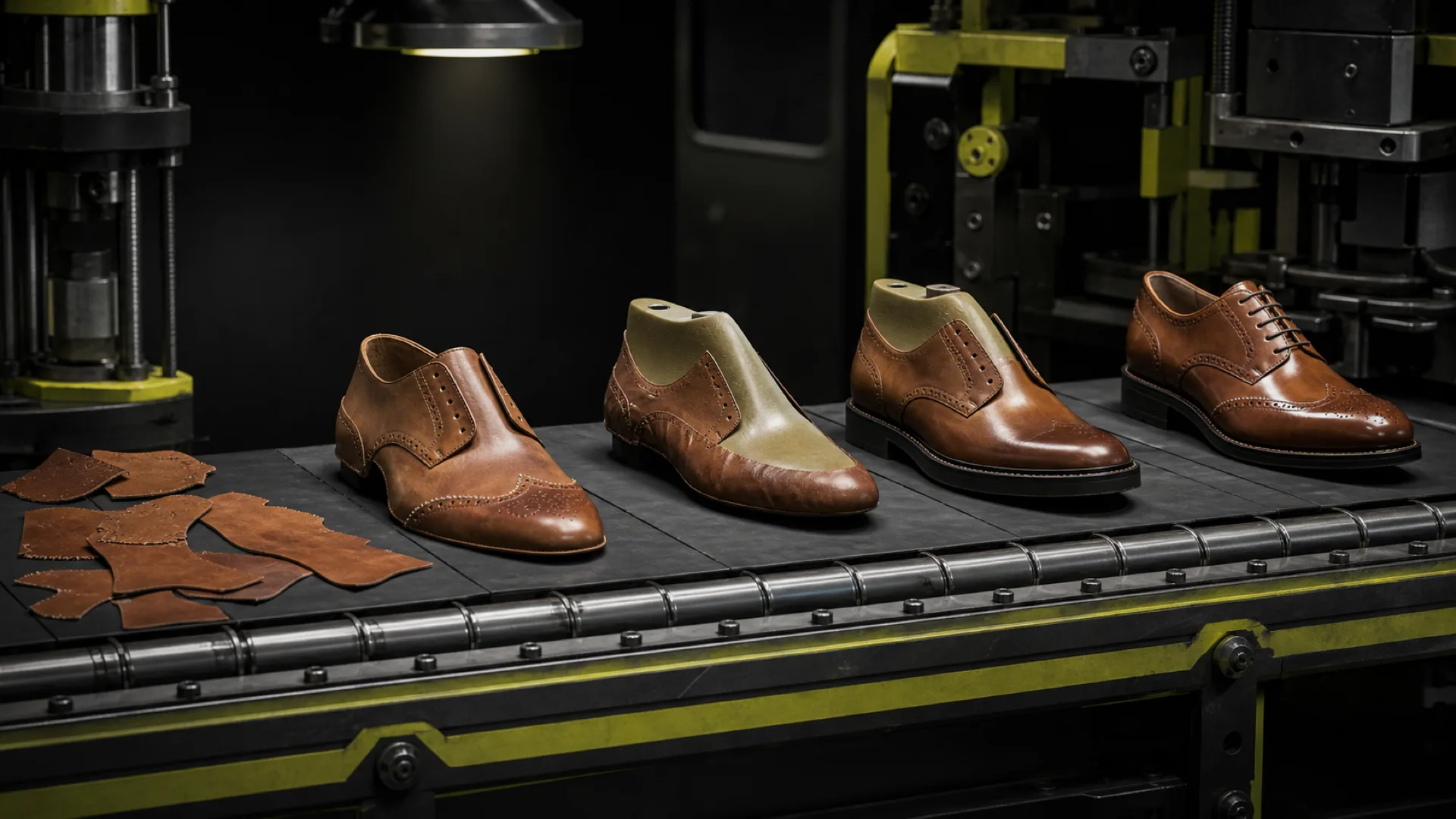
A pair of shoes passes through more human hands than almost anything else you own. Even in a modern factory, a single pair typically involves dozens of separate operations, and most of them are still done by a person at a station with a machine. Understanding that sequence is what separates designing shoes that can be made from designing shoes that come back wrong.
Key Takeaways
- A shoe is made from four material families: upper materials, lining, reinforcements and soling. Each has its own selection logic.
- Production runs as a station sequence — cutting, skiving, closing, lasting, sole attachment, finishing — and each station constrains what the design can ask for.
- Lasting is the pivotal operation: the flat upper is pulled over the last and becomes three-dimensional. Most construction problems surface here.
- Leather is graded and directional. Where a piece sits on the hide changes how it behaves in the finished shoe.
- Nearly every step is decided upstream by the designer, usually without realising it. Piece count and material thickness set the cost.
What Are Shoes Made Of?
Shoe materials divide into four groups, and a single pair usually draws from all four.
Upper materials
The visible outside of the shoe.
- Leather — still the reference material for structured footwear. Full-grain keeps the hide's natural surface and is the strongest; corrected-grain is buffed and coated; suede and nubuck are sanded finishes. Thickness matters as much as type: the same design in 1.2 mm and 1.6 mm leather fits differently and shapes differently.
- Textiles — canvas, knit, mesh, woven synthetics. Dominant in athletic footwear because they can be engineered zone by zone for stretch and breathability.
- Synthetic leather (PU, microfibre) — consistent, cheaper, no hide defects, easier to cut with no grain direction to respect. Weaker in breathability and long-term wear.
- Rubber and TPU — for overlays, toe bumpers and structural elements.
Lining
A second complete set of pieces between the upper and the foot: softer leather, or a textile chosen for moisture handling. It is cut from its own pattern, not the upper's.
Reinforcements
The invisible layer that keeps a shoe's shape: toe puff in the front, counter at the heel, shank under the arch, insole board underneath, plus backers and tapes controlling stretch along seams. These are what "structured footwear" means in practice.
Soling
- Leather — traditional, resoleable, formal; poor in wet conditions
- Rubber — grip and durability, in many compounds and hardnesses
- TPU — hard-wearing, used for outsoles and structural plates
- EVA — light and cushioning, the standard midsole foam
- Cork and crepe — cork for footbeds that mould to the foot, crepe for a distinctive soft natural rubber sole
Every one of these appears in the bill of materials with a thickness, a supplier reference and a consumption figure, because that table is what sets the shoe's cost. The tech pack is where it lives.
How a Factory Makes a Shoe
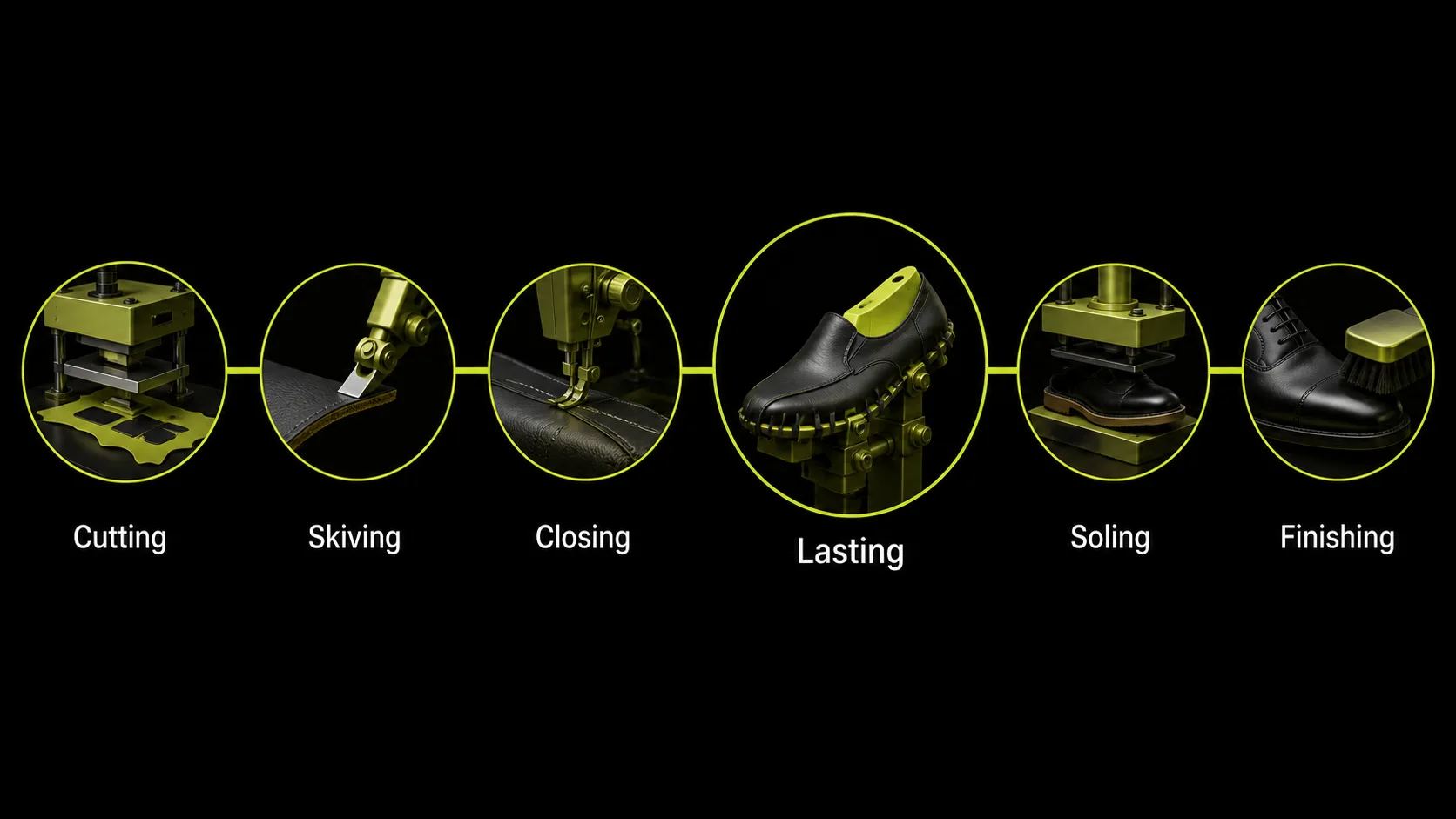
The sequence is stable across most footwear, whatever the style.
1. Cutting (clicking)
Pieces are cut from hides or rolls, either with dies on a press or by automated blade or laser. For leather this is a skilled judgement call, not a mechanical one: hides carry natural defects and vary in stretch across their area, so the cutter places each piece where the material suits its job. The vamp needs the most stable region; a small hidden reinforcement can come from a weaker area.
Grain direction is decided here. Leather stretches more across the hide than along the backbone. A piece cut on the wrong axis distorts during lasting — and the fault is invisible until the shoe is on the last.
2. Skiving and preparation
Edges are thinned (skived) so overlapping pieces do not build up bulk at the seams. Edges to be folded are skived and creased; holes are punched; reinforcement tapes are applied. Unglamorous work that decides whether the finished shoe looks crisp or lumpy.
3. Closing (stitching the upper)
The pieces are assembled into a three-dimensional upper. Operators work in sequence, each adding specific seams, with stitch type and density specified per seam. Eyelets, hardware and the lining go in here.
At the end of closing, the upper exists but is soft and shapeless — it has no form of its own yet.
4. Lasting
The pivotal operation. The last is inserted into the upper, the insole is attached to its bottom, and the upper is pulled down and fixed over the last's edge under tension. The shoe becomes three-dimensional here, taking the last's shape permanently.
This is where pattern errors surface. If the flattening was wrong, the upper will not close cleanly: it puckers, gaps at the seams, or pulls a design line out of position. The lasting allowance — the extra material at the bottom edge, decided in the pattern — is what the machine grips. Too little and it cannot hold; too much and it bunches under the insole.
The upper is then heat-set so it holds the shape, and left on the last while the sole is attached.
5. Sole attachment
The method depends on the construction decided at the brief stage — cemented, Goodyear welted, Blake, vulcanised or injected. Each has its own machinery and its own upper requirements, which is why construction cannot be changed late without re-cutting the pattern. Parts of a shoe sets out the five methods and what each means for repairability.
6. Heel attachment and finishing
The heel is fitted, edges are trimmed and burnished, the sole edge is coloured and polished, the sock lining goes in, laces are threaded. Finishing is where a shoe stops looking like a manufactured object.
7. Quality control
Pairs are checked for symmetry between left and right, seam quality, sole adhesion, and against the specification. Rejects at this stage are expensive, which is why the specification matters.
8. Packing
Tissue, box, labelling, barcode — all of it specified in the tech pack, all of it a place where an unstated detail becomes someone else's decision.
Why the Process Constrains the Design
Everything above is decided upstream, mostly by people who never visit the factory.
Piece count is operations. Each extra panel is a cut, a skive, a stitch line and a tolerance. A twelve-piece upper is not a budget upper regardless of what the leather costs. This is the most common way a design becomes unmakeable at its target price.
Material thickness changes fit. A design specified in 1.2 mm leather and made in 1.6 mm fits tighter and shapes differently over the last. Thickness is a fit specification, not a finish preference.
Grain direction has to be planned. If a piece must be cut on a particular axis, the pattern says so — otherwise the cutter decides, and the decision shows up after lasting.
Construction is an early, binding choice. It determines the upper's bottom allowance, so switching from cemented to welted mid-development means a new pattern.
The designers who avoid these problems are the ones who understand what happens at each station. That is why footwear development runs in a fixed order: brief, last, design, pattern, tech pack, sample, review, grading. The factory sequence is the reason the design sequence exists.
FAQ
What are shoes made of?
Four material families. Upper materials (leather, textiles, synthetic leather), lining (softer leather or moisture-handling textile), reinforcements (toe puff, counter, shank, insole board) and soling (leather, rubber, TPU, EVA, cork). A single structured shoe commonly contains fifteen to forty individual pieces drawn from all four, most of them invisible once finished.
How are shoes made step by step?
Cutting the pieces from hides or rolls; skiving and preparing the edges; closing, where the pieces are stitched into a three-dimensional upper; lasting, where the upper is pulled over the last and takes its shape; sole attachment by the chosen construction; heel attachment and finishing; quality control; packing. Most of these stations are still operated by people, which is why the operation count drives cost.
What is lasting in shoemaking?
The operation where the soft, closed upper is pulled over the last under tension and fixed to the insole, becoming three-dimensional and permanently taking the last's shape. It is the pivotal step: a pattern error that was invisible on screen shows up here as puckering, seam gaps or a design line out of position. The lasting allowance is the extra material at the bottom edge that the machine grips.
Are shoes made by hand or by machine?
Both, at nearly every station. Machines do the cutting presses, stitching, lasting and sole pressing, but a person operates each one and makes judgement calls — where to place a piece on a hide, how much tension to pull. Fully automated shoe production exists only for simple injected constructions. Bespoke shoemaking is hand work throughout, and is a different craft from factory production.
What is the most expensive part of making a shoe?
Labour, usually — the number of operations, which follows from piece count and construction. Materials matter, but a simple design in good leather often costs less to produce than a complex design in cheap material, because every additional panel adds cutting, skiving, stitching and a chance of rejection. Sole tooling is a separate large cost when a new mould is required.
How long does it take to make a pair of shoes?
In a factory, the active production time for a pair is measured in hours spread across stations, but the pair moves through the line over a day or more, with rest time for adhesives and heat-setting while the shoe stays on the last. Development from design to confirmed sample is a different timescale entirely — weeks to months, driven by sample rounds.
What is the difference between how sneakers and dress shoes are made?
The stations are broadly the same, but the materials and construction differ. Sneakers use engineered textiles, EVA midsoles and cemented or vulcanised construction, with more bonding and less stitching. Structured dress shoes use leather, stiffening reinforcements and stitched constructions such as Goodyear welting or Blake, with more hand finishing. Sneaker uppers also carry more separate overlay panels, which is why their piece counts are often higher than they look.
From Process to Design
Knowing how shoes are made is not factory trivia — it is the constraint set every footwear designer works inside. The reason a technical office insists on grain direction, thickness and lasting allowance is that each one has a station where it either works or does not.
The parts of a shoe are what those stations assemble, and the footwear design glossary collects the terminology you will hear on a factory floor.
I'm Susanna Zampieri — 3D footwear designer, official Icad Universe trainer and iCad Brand Ambassador. The 3D Footwear Design course teaches the design side of this process: building on the last, engineering the pattern and producing output a factory can actually work from.