Types of Shoe Soles: Materials, Constructions and How to Choose
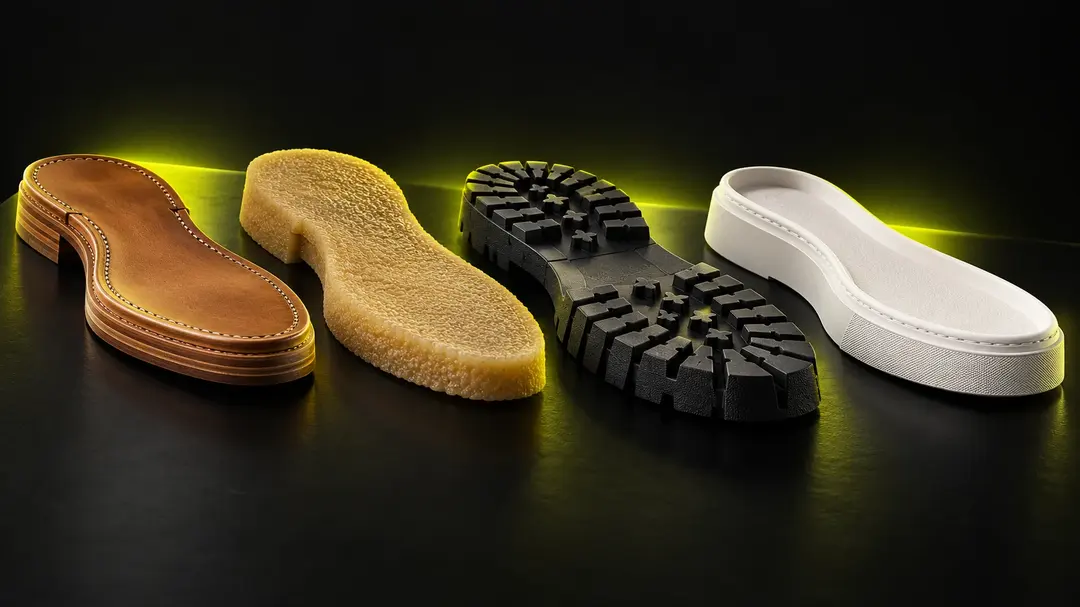
Most people pick a shoe by its upper and only notice the sole when it slips on wet pavement, wears through at the heel or feels like a plank after an hour. Yet the sole decides how a shoe grips, flexes, weighs, ages and whether it can ever be repaired.
In the studio, the sole is also the part of a project that becomes expensive to change first. This guide covers the main types of shoe soles, the materials they are made from, how they are manufactured, and how a designer chooses and specifies one.
Key Takeaways
- A shoe sole is usually a stack of layers (outsole, midsole, insole), and "sole type" can mean the material, the manufacturing method or the shape.
- Leather is refined and resoleable but slippery when wet; rubber grips and lasts; EVA and PU cushion and lighten; TPU is tough and flexible; cork insulates.
- Sole choice is tied to the construction method: a Goodyear welt expects a different sole than a cemented sneaker cupsole.
- Most brands buy unit soles from specialist factories, and every size in the run needs its own mould.
- Because moulds are costly, sole design is frozen early, long before the upper is final.
What Are the Types of Shoe Soles?
The types of shoe soles are grouped by material (leather, rubber, EVA, polyurethane, TPU, TR and cork), by manufacturing method (cut leather, injected, vulcanized, moulded unit) and by shape (flat sole, cupsole, heeled sole). A single shoe often combines several, such as a rubber outsole over an EVA midsole.
A retailer talks about "rubber soles", a cobbler about "stacked leather", a sneaker brand about "cupsoles". These are not competing categories: they answer what it is made of, how it was made and what it looks like.
I find it easiest to decide the material first, then the process that suits it, then the shape. The rest of this article follows that order.
What Are the Parts of a Sole Unit?
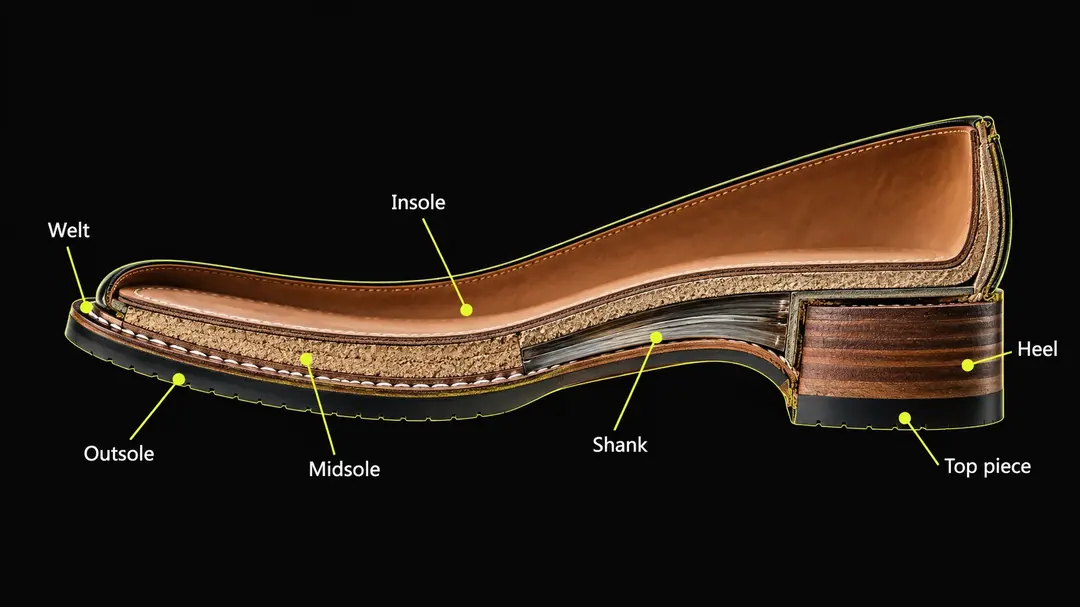
A sole unit is the whole assembly under the foot. Its main layers are the outsole (ground contact), the midsole (cushioning or structure), the insole (the board the upper is lasted onto) and, on welted shoes, the welt. The heel and its top piece sit at the back.
Here is how they fit together:
- Outsole: the layer that touches the ground. It carries the tread and takes the abrasion.
- Midsole: an optional layer between outsole and insole that adds cushioning, stability or height.
- Insole: the board the upper is attached to during lasting. The footbed or sockliner sits on top of it.
- Welt: a strip of leather or synthetic that joins upper and sole in welted construction.
- Heel: the raised block at the rear, built from stacked layers or moulded in one piece.
- Top piece: the replaceable cap on the bottom of the heel that meets the ground.
For a full tour of every component, see parts of a shoe.
What Are the Main Shoe Sole Materials?
The main shoe sole materials are leather, natural and synthetic rubber, EVA foam, polyurethane (PU), thermoplastic polyurethane (TPU), thermoplastic rubber (TR) and cork. Each trades weight, grip, durability, flexibility and repairability differently, and none is best at everything.
The table gives general trade tendencies. Exact behaviour depends on the compound, density and thickness, so always check supplier data.
| Material | Weight | Grip | Durability | Flexibility | Resoleable | Typical shoe |
|---|---|---|---|---|---|---|
| Leather | Medium | Low when wet | Moderate | Stiff at first, softens | Yes, easily | Dress shoes, Oxfords |
| Rubber (solid) | Medium to heavy | High | High | Varies by compound | Often | Boots, work shoes, loafers |
| Crepe rubber | Medium | Good | Moderate, soft | Flexible | Sometimes | Desert boots, casual shoes |
| Lug rubber | Heavy | Very high | High | Stiffer | Often | Hiking and work boots |
| EVA | Very light | Low to medium | Lower, compresses over time | Flexible | No | Sneakers, sandals, midsoles |
| PU | Light to medium | Medium | Good, can degrade with age | Flexible | Rarely | Comfort shoes, boots |
| TPU | Medium | Medium to high | High | Flexible, springy | No | Sports soles, overlays, inserts |
| TR | Medium | Good | Moderate | Flexible | No | Fashion flats, budget soles |
| Cork | Light | Medium | Moderate | Moderate | Sometimes | Footbeds, sandals, wedges |
Leather soles
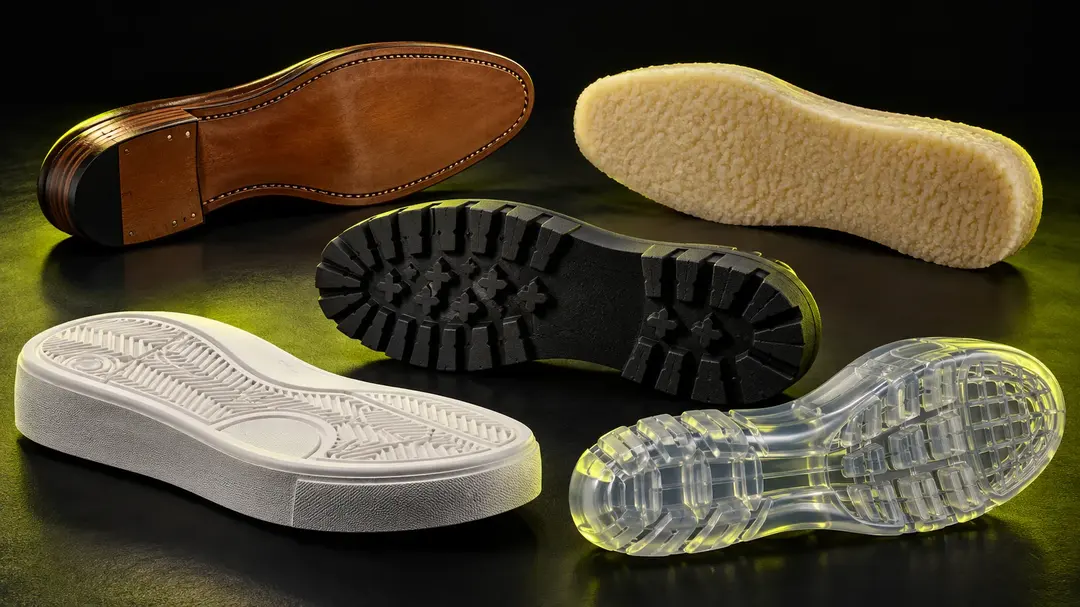
Leather soles come from vegetable- or chrome-tanned hides, cut and finished by hand or die. They look refined and let the foot breathe. They are also slippery on wet surfaces and wear faster on rough ground. Their big advantage is repair: a cobbler can replace them again and again.
Rubber soles
Rubber is the workhorse. Natural rubber is soft and grippy, synthetic compounds can be tuned for abrasion resistance, oil resistance or low weight. Crepe is a soft, crinkled natural rubber that feels comfortable but picks up dirt and wears down fairly quickly. Lug soles have deep, chunky tread patterns for traction on loose ground. Several brands sell branded rubber units with their own compounds, but I would never specify one from a brand name alone. Ask for the compound and hardness.
EVA and PU
EVA (ethylene-vinyl acetate) is a lightweight foam, and the reason most sneaker midsoles feel soft. It compresses over time, so cushioning fades. The polymer is described on Wikipedia. PU foam is denser and usually more durable, though some formulations can crumble with age and moisture, a problem vintage shoe owners know well.
TPU and TR
Thermoplastic polyurethane is a tough, abrasion-resistant plastic that stays flexible. Designers use it for outsole sections, heel counters and shanks. TR (thermoplastic rubber) is a rubber-like compound that is cheap to injection mould, which is why you find it on many fashion flats.
Cork
Cork is light and insulating, and it moulds to the foot over time. It is common in footbeds and wedge heels, usually covered in leather or fabric, and is less often used as an exposed outsole because it abrades.
How Are Shoe Soles Manufactured?
Shoe soles are manufactured by cutting and stacking leather, injecting molten or liquid material into a mould (PU, TPU, TR, EVA), or vulcanizing rubber under heat and pressure. The method determines cost, minimum order, finish and which shoe constructions the sole can be attached to.
Cut and stacked leather
A leather sole is cut from a hide with a die or knife, then shaped, pressed and finished at the edge. Heels are often built by stacking leather or board layers, glued and nailed, then trimmed. It is traditional, flexible in small runs and mostly manual.
Injected soles
For PU, TPU and TR, the material is injected into a metal mould that holds the tread and edge shape. Some processes inject directly onto the lasted upper. Others make a standalone unit that is bonded later. Injection gives fine detail and fast cycles, at the price of mould cost.
Vulcanized soles
In vulcanization, rubber is heated with curing agents so it hardens and stays elastic. Classic canvas sneakers use a vulcanized process: the foxing strip and sole are applied to the upper and cured together, giving the familiar flat, flexible feel and a strong bond.
Compression-moulded EVA and rubber
Compression moulding places a cut blank of EVA or rubber in a heated mould and presses it into shape. It is common for midsoles and outsoles in athletic and casual footwear.
Soles reach the shoe in two main ways. Directly attached soles are injected or vulcanized onto the upper, while unit soles are finished separately and bonded or stitched on afterwards. Most small brands use unit soles, because they avoid owning a mould line.
Cupsole or Flat Sole: What Is the Difference?
A cupsole is a one-piece sole with raised sidewalls that wrap the bottom edge of the upper, while a flat (or vulcanized) sole is a thinner slab with a separate foxing strip. Cupsoles feel sturdier and more structured, flat soles feel closer to the ground and more flexible.
In sneakers, the cupsole is stitched or cemented to the upper, and the wall hides the join. It is the standard for court-style shoes. A flat vulcanized sole has a visible foxing band and usually a lower profile.
For a designer, the choice changes the whole look. A cupsole adds visual weight. A flat sole keeps the silhouette sleek and demands cleaner pattern work at the lasting margin.
Where Do Brands Get Their Soles?
Most brands buy ready-made unit soles from specialist sole factories, which hold moulds for popular styles in a full size run. Custom soles are possible, but each size needs its own mould, so a bespoke design carries a significant up-front tooling cost.
A factory offers a range of shapes and treads you can order in small minimums. When a brand wants its own tread or logo, it commissions moulds. A full run means moulds for every size, and half-sizes often need their own.
Prices vary a lot, so I won't quote numbers. Ask suppliers for a tooling quote and a minimum quantity before you commit to a custom design. This is where many first collections run into trouble: the design is lovely, but the budget doesn't cover mould costs.
How Does the Sole Interact With Shoe Construction?
The sole you choose limits the construction you can use, and the other way round. Goodyear and Blake constructions suit stitched leather or rubber soles, cemented construction suits most injected and moulded units, and vulcanized construction is a process of its own that makes the sole part of the build.
Think of it as a compatibility check:
- Goodyear welt: needs a sole thick enough to take stitching and a leather or rubber outsole. Highly resoleable.
- Blake stitch: slimmer, uses a flexible leather or thin rubber sole. Resoleable with the right machine.
- Cemented: the sole is glued to the upper. Works with nearly every moulded material, but repair is limited.
- Vulcanized: rubber cured with the upper. Not realistically resoleable.
I cover the differences in detail in shoe construction methods, and you can see where lasting fits in how shoes are made.
The sole and the last bottom
The sole must match the last bottom. The shape of the forepart, the heel seat, the shank curve and the toe spring all come from the last, and the sole unit has to follow them. A mismatch shows up as gaps along the edge, a rocking heel or a toe that lifts.
When I build the pattern, I check the last bottom against the sole unit outline before anything else. If you're new to this, what is a shoe last explains why the last is the foundation of fit.
How Does a Designer Specify a Sole?
A designer specifies a sole in the tech pack by naming the material and hardness, the construction and attachment method, the sole unit reference or mould drawing, the thickness at key points, the heel height, the colour and any finishing. Missing details get filled in by the factory's defaults.
A sound sole specification covers:
- Material and compound: for example "solid rubber, hardness range X", not just "rubber".
- Unit reference: the supplier's code, or your own drawing if custom.
- Dimensions: thickness at forepart and heel, heel height, shank type.
- Attachment: cemented, stitched, vulcanized.
- Finish: edge treatment, colour, logo or stamping.
- Size range: which sizes have moulds available.
Our full walkthrough is in the shoe tech pack guide.
Why sole design is frozen early
Sole design is frozen early because moulds take time and money, and they cannot be edited cheaply once cut. The upper can still be revised through sample rounds.
In practice the order is: last first, sole unit second, upper third. A late change to the sole unit can mean new lasts and new patterns. A late change to the upper is a nuisance, but it usually leaves the tooling untouched.
How Do You Model a Sole in 3D?
You model a sole in 3D by starting from the last bottom, building the outsole outline and thickness, adding tread, shank, heel and edge details, then checking fit and clearance against the last before exporting for mould making. Doing this digitally catches errors before expensive tooling.
In Icad Universe, the sole is built directly on the last, so the outline, the bottom curve and the heel seat stay linked. That lets you test thickness, tread depth and wall height visually, and send a clean model to the mould maker. Our detailed workflow is in 3D sole and heel design.
How Do You Choose the Right Sole?
Choose the sole by working backwards from the use: what surface, how many hours on foot, what weather, what weight, what budget and whether repair matters. Then pick the material, then the construction, then the shape. No single sole wins on every criterion.
A quick decision guide:
- Formal and refined: leather, or a thin rubber sole for wet-weather dress shoes.
- Everyday walking: rubber, or an EVA midsole with a rubber outsole.
- Trail or work: lug rubber with a stiffer shank.
- Light summer shoes: EVA, cork or crepe.
- Repairable, long-life shoes: welted construction with leather or rubber.
FAQ
What is the most durable shoe sole material?
Solid rubber and TPU are generally the most abrasion-resistant common soles, with leather somewhat behind on rough surfaces. Durability depends on the compound, hardness and tread thickness, so compare the supplier's data rather than the material name alone.
Is a rubber or leather sole better?
Rubber is better for grip, wet weather and long wear, while leather is better for a slim, refined look and for breathability. Leather is easy to resole, and rubber is often resoleable too. Pick leather for formal use and rubber for daily wear.
What is an EVA sole?
An EVA sole is made of ethylene-vinyl acetate, a light, soft foam that cushions well. It is common in sneaker midsoles and sandals. EVA compresses over time and cannot normally be resoled, so it suits comfort and weight more than longevity.
What is a TPU sole?
A TPU sole is made of thermoplastic polyurethane, a tough and flexible plastic. It resists abrasion well and can be injection moulded in detailed shapes. Designers also use it for shanks, heel counters and outsole sections that need strength.
Why do sole moulds cost so much?
Each size in a run needs its own metal mould, and a mould has to be precise to hold tread and edge detail. Tooling costs are paid before the first pair is made, which is why custom soles suit larger or committed runs.
Can any shoe be resoled?
No. Goodyear-welted and many Blake-stitched shoes are designed to be resoled. Cemented and vulcanized shoes can sometimes be repaired, but the result is usually limited, and EVA-based soles generally cannot be replaced.
Designing Soles Is a Skill You Can Learn
If you want to learn how soles, lasts and uppers are designed together in 3D, the 3D Footwear Design course walks through the whole workflow, from the last to the finished tech pack.
Susanna Zampieri is a 3D footwear designer with more than ten years in the industry, a direct Brand Ambassador of iCad and an official trainer of Icad Universe.