Shoe Construction Methods: Cemented, Strobel, Blake and Goodyear Welt Explained
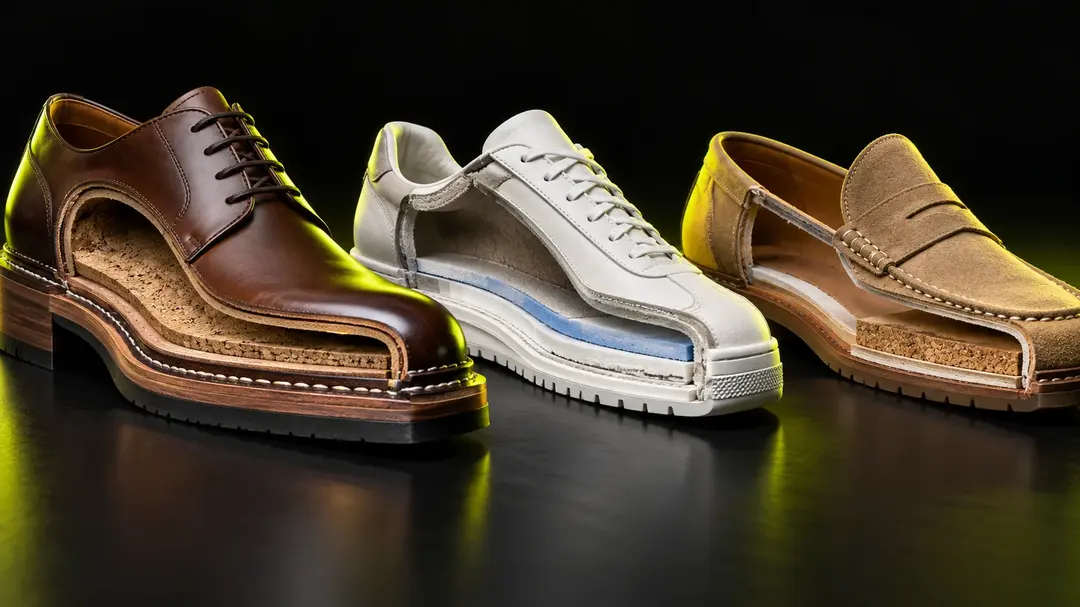
Two shoes can look identical on a shelf and behave completely differently on the foot and in the repair shop. The difference is almost always construction: the method that joins the upper to the sole. It sets flexibility, weight, water resistance, cost and whether the shoe can ever be resoled.
Most guides explain construction as a buyer's checklist. This one takes the designer's side: each method asks for a different pattern allowance, a different insole and a different line in the tech pack. Choose it late and you redraw the pattern.
Key Takeaways
- Construction is how the sole is attached to the upper: glued, stitched to the insole, stitched to a welt, or fused by heat.
- Cemented and Strobel are the cheapest and lightest. Goodyear welt and Blake Rapid are the easiest to resole; Blake can be resoled only by specialists.
- Goodyear welt and stitchdown are among the most water resistant, and welted shoes are the benchmark for repairability.
- Each method changes the lasting allowance, the insole and the sole spec, so decide it before the pattern is final.
- A shoe's category and price point usually point to its construction before you design a single line.
What Are Shoe Construction Methods?
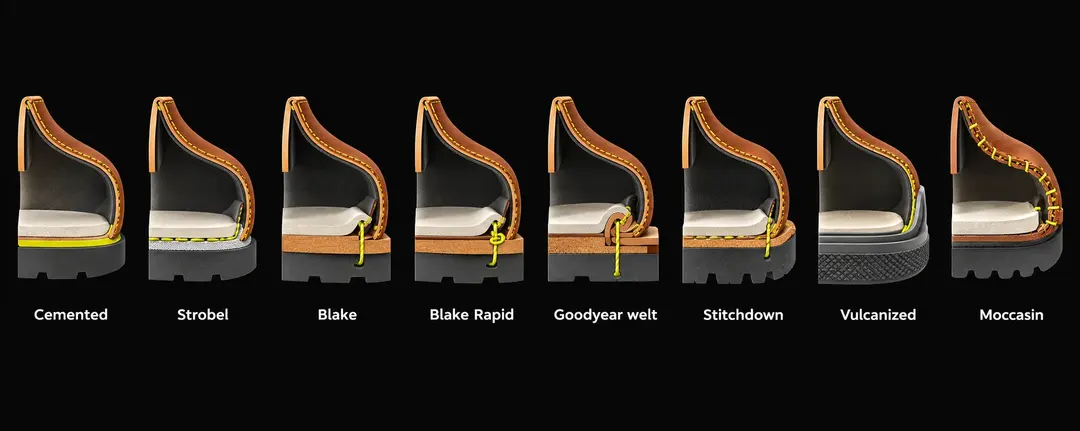
Shoe construction is the method used to attach the upper to the sole unit, and the main types are cemented, Strobel, Blake stitch, Blake Rapid, Goodyear welt, stitchdown, vulcanized and moccasin.
Every method answers the same question: how does the lasted upper become permanently joined to something you can walk on? Some answers use adhesive, some use thread, some use heat and pressure. Many shoes combine two, such as a cemented sole reinforced with a stitch.
The method is not a style choice you can swap at the end, because it is bound up with the last, the insole, the sole and the cost target. In the studio, I treat it as one of the first decisions on a new model, alongside the last and the material family. For the factory sequence these methods plug into, see how shoes are made.
Cemented Construction
Cemented construction is the method in which the outsole is glued to the lasted upper with adhesive and pressure, with no stitching holding the sole on.
It is the most common construction in the world, and for good reason. After lasting, the upper's bottom edge is lasted onto the insole, the surface is roughened, adhesive is applied to both parts, and the sole is pressed on. The process is fast, highly automated and suits almost any sole shape or material.
Its strengths are low cost, light weight and design freedom, from cupsoles to chunky platforms. Its weakness is repair: once the sole wears out or the bond fails, resoling is limited or impossible.
Quality varies widely: a well-prepared bond is durable, while a rushed bond on a poorly prepared surface peels, which is why bond tests matter in production.
What cemented changes for the designer
The upper is lasted over the insole board and the margin is folded under it, so the pattern needs a lasting allowance on the bottom edge. The sole's rim or wall covers that edge, so you design the join line, not a visible seam. On cupsole shoes the upper sits inside the sole wall, which fixes how high the upper stops.
Strobel Construction
Strobel construction is a method in which the upper is stitched to a flexible fabric sock, the Strobel board, and the sole unit is then cemented underneath.
The name comes from the Strobel stitching machine. Instead of lasting the upper edge down over a rigid insole, the factory closes the upper into a sock-like bag by stitching its bottom edge to a lightweight fabric panel. The last then goes inside, and the sole is attached below.
The result is a lighter, more flexible shoe with a softer underfoot feel. That is why Strobel dominates running shoes, trainers, casual sneakers and many comfort styles. Because the stitching sits inside, there is no hard insole edge underfoot.
The trade-off is structure. A Strobel sock gives less rigidity than a lasted insole board, and the shoe is not designed to be resoled.
What Strobel changes for the pattern
The Strobel sock becomes its own pattern piece, cut to the bottom shape of the last. The upper pattern needs a stitching allowance at the bottom edge to join the sock, and the join must follow the last's bottom curve accurately or the shoe twists. In 3D, I model the sock from the last's bottom surface, then flatten it, which is the same logic described in shoe pattern flattening from 3D to 2D.
Blake Stitch Construction
Blake stitch construction (also known as McKay) is a method in which a single seam, made by a Blake machine from inside the shoe, joins the upper, the insole and the outsole together in one pass.
The lasted upper edge sits flat on the insole, and the outsole is placed against it. A special machine passes thread through the outsole, the upper edge and the insole. The thread is visible on the insole inside the shoe, usually covered by a sockliner, and recessed in a channel on the outsole. The finished sole is slim and flexible, with no welt visible.
The sole sits close to the upper, giving a low profile and a flexible walk, which is why Blake is popular in Italian dress shoes, loafers and fine leather footwear.
The downsides are specific. The stitch passes through to the shoe's interior, so water can enter more readily, and the seam can be felt through a thin or worn lining. Resoling is possible, but only for specialists with the right machine, and it goes through the insole each time.
What Blake changes for the designer
Because the seam goes through the insole, the insole must be a proper stitchable board, and the lining and sockliner must cover the seam. There is no welt or rib to build, so the allowance is sized for a flat insole. Sole thickness is limited by what the machine can stitch through, so the sole spec must name a thickness the factory can actually sew.
Blake Rapid Construction
Blake Rapid construction is a variation of the Blake method that adds a midsole: the upper is stitched to the insole and midsole, and the outsole is then stitched separately to the midsole.
By splitting the work in two, the Blake Rapid solves the main Blake weaknesses. The stitch through the insole is isolated from the sole's outer stitch, so the shoe resists water better. The sole can also be replaced by cutting the outer stitch, without touching the first seam. The shoe gains more depth and a sturdier feel.
You will see it in sturdier leather shoes and boots where the maker wants a slim profile with more robustness. It sits between Blake and Goodyear welt in cost and durability.
For the designer, the extra layer means a thicker sole stack. The pattern allowance stays similar to Blake, but the sole and midsole must be specified as separate items.
Goodyear Welt Construction
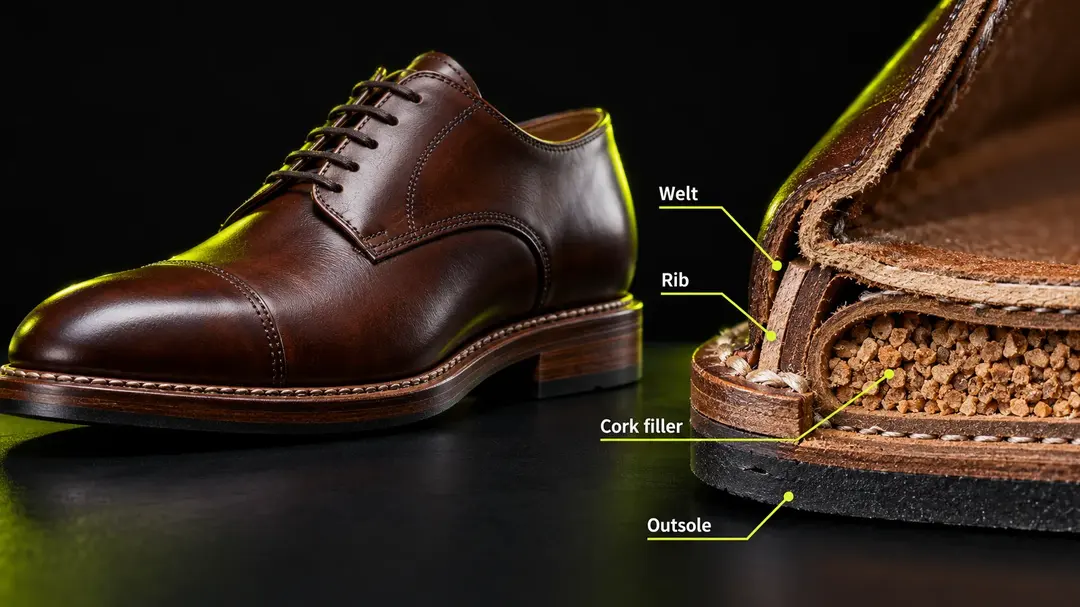
Goodyear welt construction is a method in which a strip of leather, the welt, is stitched to a rib on the insole and to the upper, and the outsole is then stitched to the welt.
Developed in the 19th century and still the benchmark for durable shoes, it uses two separate seams, as Wikipedia's entry on the Goodyear welt outlines. The first seam joins upper, lining and welt to a rib, called the gemming, that is cut or attached to the insole. The second seam attaches the outsole to the welt. A cork or similar filler sits in the cavity between.
This design is why Goodyear welt shoes are so easily resoled: the outsole seam can be cut and replaced without touching the upper. The filler also moulds to the foot over time, and the double barrier makes them more water resistant than Blake.
The costs are weight, initial stiffness and price: the process needs more steps and more skilled work, so welted shoes sit at the higher end of the market.
Welt margin and the designer
Welt construction adds the visible welt margin around the shoe's edge, and you design it: how far the welt projects past the upper, and how that outline looks at the toe, waist and heel. The pattern needs a lasting allowance sized for the rib and welt, and the last needs a suitable bottom edge. The welt width and sole edge treatment belong in the tech pack, as explained in the shoe tech pack guide.
Stitchdown Construction
Stitchdown construction is a method in which the upper's bottom edge flares outward and is stitched directly to the midsole or outsole, with no welt.
Veldtschoen is its best-known variant. It produces a very water-resistant shoe, because the seam sits outside the upper and the flange acts as a barrier. Outdoor boots, hiking shoes and rugged derbies use it.
The look is distinctive: a visible flange running around the base. The pattern includes an outward allowance rather than an inward one. That is the opposite of most methods, and it should be flagged in the pattern file so the factory does not fold it under.
Vulcanized Construction
Vulcanized construction is a method in which a rubber sole and the upper are bonded together by heat and pressure, which cures the rubber into a single flexible unit.
Think classic canvas sneakers. The upper is lasted, a rubber foxing and outsole are placed around it, and the whole shoe goes into an oven, where heat cures the rubber and fuses it to the upper, as described in Wikipedia's article on vulcanization. It suits canvas or simple uppers that tolerate heat, and rubber soles. For the designer, material choices are restricted, and the toe cap and foxing are part of the construction, not decoration.
Moccasin Construction
Moccasin construction is a method in which a single piece of leather wraps under and around the foot, and is sewn to a top piece, called the vamp, with a stitched seam around the toe.
It is among the oldest of the methods here and still defines the moccasin, the driving shoe and many soft-soled loafers. The upper often forms most of the bottom, and a thin sole may be added for protection.
For pattern work, it is unusual because the base and sides are one shape. The pattern does not separate neatly into the upper and the bottom, and the last must allow for the wrap.
How Do the Construction Methods Compare?
The main differences among construction methods are flexibility, resoleability, water resistance and cost, with Goodyear welt leading on repairability and water resistance, and cemented and Strobel leading on cost and lightness.
The table below sets the main methods side by side. Treat the ratings as general guidance: sole material, leather quality and factory skill move any shoe up or down.
| Method | Flexibility | Resoleable | Water resistance | Cost | Typical shoes | Lasting method | What changes in the pattern |
|---|---|---|---|---|---|---|---|
| Cemented | High | Limited | Moderate | Low | Sneakers, flats, fashion shoes | Lasted over insole board, sole glued | Bottom lasting allowance, join under sole wall |
| Strobel | Very high | Not designed for it | Moderate | Low | Running shoes, trainers, casual | Upper stitched to fabric sock, then lasted | Separate sock piece, stitching allowance |
| Blake | High | Yes, specialist | Lower | Medium | Dress shoes, loafers | Lasted to insole, stitched through | Smaller allowance, stitchable insole |
| Blake Rapid | Medium to high | Yes | Medium | Medium to high | Boots, sturdy dress shoes | Lasted to insole and midsole | Midsole added, stack thicker |
| Goodyear welt | Low at first | Yes, easy | High | High | Dress shoes, boots, brogues | Lasted to gemmed insole | Welt allowance, welt margin, feather edge |
| Stitchdown | Medium | Yes | Very high | Medium to high | Outdoor boots, rugged derbies | Upper flange stitched outward | Outward flare instead of inward fold |
| Vulcanized | Medium | No | Moderate | Low to medium | Canvas sneakers | Lasted, rubber cured by heat | Heat-tolerant materials, foxing design |
| Moccasin | Very high | Limited | Low | Medium | Moccasins, driving shoes | Wrapped on last, sewn at vamp | Wrap shape, no clear base split |
Match the method to the category: running shoes use Strobel and cement, classic brogues use welt, slim loafers use Blake. Fighting the category usually costs you in price, comfort or credibility.
How Does Construction Change the Pattern, the Last and the Tech Pack?
Construction changes three design files: the pattern, through the lasting allowance and any extra pieces; the last, through its bottom shape and edge; and the tech pack, through the sole spec and construction notes.
When I build the pattern in the studio, the construction method is already fixed, because it sets numbers I cannot guess.
The pattern
The lasting allowance, the margin that folds under the last, differs by method. A cemented shoe needs an allowance that folds onto the insole. A welted shoe needs one sized to the rib. A Strobel shoe needs a stitching allowance and an extra sock piece. If you want the full pattern workflow, see the article on shoe pattern flattening.
The last
The last's bottom and edge define where the upper ends and the sole begins. A welted last needs a bottom edge suited to the rib and welt, and a cupsole last has a different bottom contour. The basics are covered in what is a shoe last, and the lasting step itself in shoe lasting.
The tech pack
The tech pack names the method in plain words, then backs it with specifics: sole unit, welt width, stitch type and density, insole type, and adhesive or bond requirements. Leave it out and the factory picks a default, which is often the cheapest option. See parts of a shoe for the vocabulary, such as insole, midsole, welt and shank, that these notes depend on.
A pattern built for one construction can be wrong for another by a few millimetres of allowance, and the error often appears as a puckered edge at the lasting stage rather than in the 3D model. Build the allowance for the construction you will actually ship.
Which Construction Should You Choose?
Choose construction by category, price point and repair expectations: Strobel or cemented for sport and fast fashion, Blake for slim leather shoes, Goodyear welt or Blake Rapid for durable leather, stitchdown for outdoor.
Three questions settle most decisions. Who is the customer and what do they pay? Will anyone resole the shoe (if so, favour Blake Rapid or welt)? What is the use: wet weather points to welt or stitchdown, light daily comfort to Strobel.
The more manual stitching, the higher the price. Before committing, ask the factory which methods it runs well, since a factory strong in cementing may only offer welt through a subcontractor.
FAQ
What are the main types of shoe construction?
The main types are cemented, Strobel, Blake stitch, Blake Rapid, Goodyear welt, stitchdown, vulcanized and moccasin. Cemented and Strobel use adhesive and are the most common. Blake and Goodyear welt use stitching and allow resoling. Each suits different categories and price points.
What is the difference between Blake and Goodyear welt?
Blake uses one seam through the outsole, upper and insole, giving a slim, flexible shoe. Goodyear welt uses a separate welt and two seams, which gives better water resistance and easier resoling. Blake is lighter and sleeker. Goodyear welt is sturdier and generally more expensive.
Is Strobel construction good quality?
Strobel is good quality for what it is designed to do: light, flexible, comfortable shoes such as sneakers and running shoes. It is not designed for resoling and offers less structure than a lasted insole. For sport and casual wear, it is a sound, widely used method.
Is cemented construction bad?
No. Cemented construction is the most common method worldwide, and a well-made bond lasts for years. Its limits are repair and, in cheap shoes, bond quality. For sneakers, fashion shoes and many everyday styles, a well-prepared cemented sole is a perfectly good choice.
Can you resole a Blake stitched shoe?
Yes, but only by a specialist with a Blake machine, and the stitch passes through the insole each time. Blake Rapid and Goodyear welt are easier to resole, because the outsole seam is separate from the one holding the upper.
Where to Go From Here
Construction is the point where design meets manufacturing. Once you can specify the method in a pattern and tech pack, factory conversations get shorter and samples come back closer to the intent. Lasting, covered in shoe lasting, and shoe pattern making follow from this decision.
If you want to learn this inside a 3D workflow, from modelling the last to flattening patterns and building the sole in Icad Universe, the 3D footwear design course walks through it step by step. The author, Susanna Zampieri, is a 3D footwear designer, direct Brand Ambassador of iCad and official Icad Universe trainer.