Parts of a High Heel Shoe: Anatomy of a Heel, Explained by a Designer
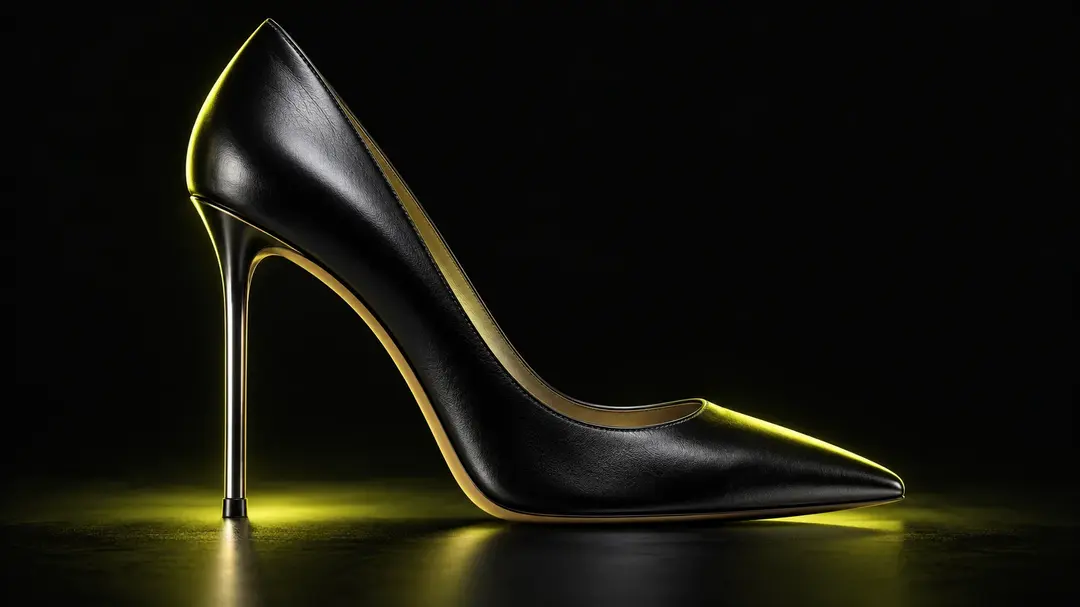
Most diagrams of a high heel shoe label five or six parts and stop there. That is enough to describe a shoe in a catalogue, but not enough to understand why one pair of heels is comfortable and another one tips you forward after ten minutes.
The difference lives in details that rarely get named: the shank under the arch, the pitch of the foot, the spigot inside a stiletto. This guide walks through every part of a high heel shoe the way a designer and pattern-maker sees it, from the heel itself to the structure it forces on the rest of the shoe.
Key Takeaways
- A high heel shoe has two groups of parts: the heel itself (top lift, breast, seat, body, core) and the parts a heel changes (shank, insole board, toe spring, pitch).
- The shank is structural in heels: it carries the load between heel and ball of the foot and keeps the arch from collapsing.
- Heel height is built into the last, so a meaningfully different heel height means a different last.
- Pump uppers have their own vocabulary: vamp, throat, topline and counter.
- In 3D CAD, the heel is modelled as its own component and checked against the last before anything is cut.
What Are the Parts of a High Heel Shoe?
The parts of a high heel shoe are the heel (top lift, breast, seat, body and internal core), the structural parts under the foot (shank, insole board, outsole), and the upper parts that wrap the foot (vamp, throat, topline, counter and lining). Together they carry body weight on a steeply inclined foot.
A flat shoe spreads weight across the whole sole. A heel concentrates it on two small areas: the ball of the foot and a heel base that can be less than a coin wide. That is why almost every part of a high heel is designed differently from its flat equivalent.
If you want the general vocabulary first, the parts of a shoe covers uppers, soles and linings for any style. Here we stay with heels.
What Are the Parts of the Heel Itself?
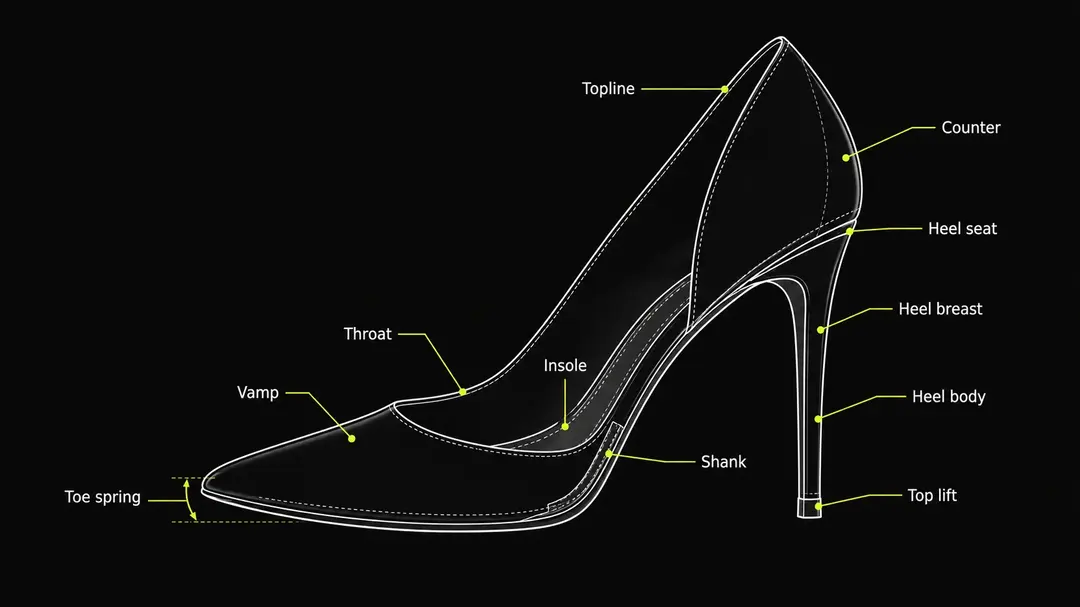
The heel itself is made of a top lift at the ground, a breast on the front face, a seat where it meets the shoe, a body in between and, in thin heels, a metal core. Each name describes a position, so once you know the layout the rest of the vocabulary follows easily.
Top lift (top piece)
The top lift is the small replaceable tip that touches the ground. It is usually plastic or rubber on women's heels, and often leather or a leather stack on classic and men's heels. It takes all the wear, which is why cobblers replace it and why a worn lift can change how the whole shoe stands.
Heel breast
The breast is the front face of the heel, the surface you see when you look at the shoe from the inside of the arch. On block and Louis heels it can be flat, concave or sculpted. It carries much of the heel's character in side view.
Heel seat
The seat is the top surface of the heel, the part that meets the shoe's seat area under the back of your foot. This is the most critical joint in the shoe. If the seat is not flat and correctly angled, the heel will wobble or sit crooked no matter how well everything else is made.
Heel body
The body is the volume between top lift and seat. It can be solid wood, injected plastic (often ABS) or stacked leather, and it may be wrapped in leather or fabric. Its profile, straight, flared, curved or tapered, defines the heel type.
Spigot (metal core)
In slim stiletto heels, a steel rod runs through the plastic body from the seat to the top lift. This metal core, often called a spigot or heel pin, gives a thin heel the strength it would never have in plastic alone. Block heels rarely need one because their cross-section is large enough.
Heel cup: a word to handle with care
"Heel cup" is used loosely in the trade. Some makers mean the shallow concave seat that holds the base of the shoe. Others use it for the rear part of the shoe that cradles your heel, which pattern-makers more commonly call the counter area. When you read a spec sheet, check which one is meant.
Why Is the Shank So Important in High Heels?
The shank is a stiff strip of steel, composite or fibreboard that runs under the arch, from the heel seat toward the ball of the foot. In heels it is structural: it holds the arch shape, carries load between heel and forefoot, and stops the sole from flexing in the waist.
In a flat shoe the shank is a comfort feature. In a high heel it is a safety feature. With the foot tilted steeply, a large part of your weight pushes the middle of the shoe downward. Without a rigid shank the waist sags, the heel rolls and the shoe loses its shape.
In the studio, the shank is one of the first things I check on a prototype that "feels wrong". Very often the problem is not the heel but a shank that is too short, too soft or sitting in the wrong position under the arch.
Shanks are usually matched to heel height. A low heel can use a short, light shank. A tall heel needs a longer, stiffer one, and the shape of the shank has to follow the curve of the last bottom. That is why shanks are specified per last and per heel, not picked from a generic bin.
How Do Insole, Toe Spring and Pitch Change in a Heel?
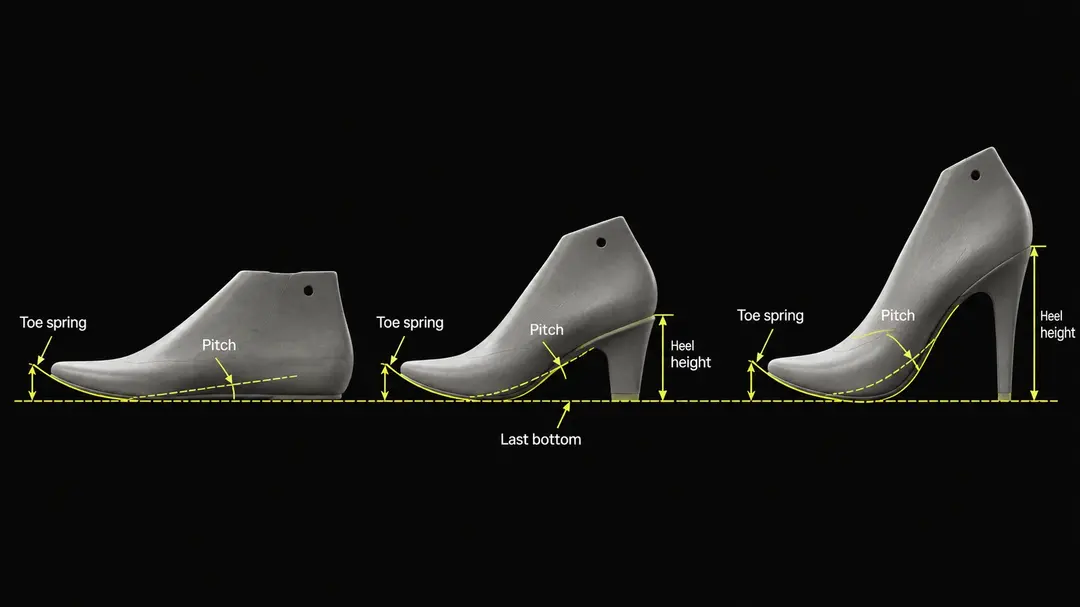
Three parts of the shoe change the moment a heel goes up: the insole board, the toe spring and the pitch. They are not parts of the heel, but they are shaped by it. Together with the shank, they determine whether a heel feels stable or punishing.
Insole board
The insole board is the stiffer layer the upper is lasted onto. In heels it is shaped to follow the inclined last bottom, and the heel is attached through it and the sole. A weak or badly formed insole board is one possible reason heels loosen over time.
Toe spring
Toe spring is the upward lift of the toe tip off a flat surface. Heels need some, because a toe that touches the ground at a steep angle makes walking awkward. It is built into the last, not added afterwards, and it behaves differently from one heel height to another.
Pitch and heel height
Pitch is the angle at which the foot sits in the shoe. As the heel rises, the pitch increases, and the entire last bottom changes shape to match. Heel height itself is normally measured from the ground to the rear of the heel seat, and it is one of the first numbers on any heel spec.
Pitch is why a 4 cm shoe and a 10 cm shoe are not the same shoe with a different heel. Their lasts have different geometry, different weight distribution and different toe spring. For more on how shape is defined, see what a shoe last is.
What Are the Upper Parts Specific to a High Heel Pump?
A pump is a low-cut shoe with no fastening, so its upper has fewer parts than a boot or sneaker but each one is under more stress. The key parts are the vamp, the throat, the topline, the counter and the lining, and they have to keep the foot from sliding forward.
- Vamp: the front section covering the toes and the instep. In a pump it can be very short, which is why a low vamp shows toe cleavage.
- Throat (or throatline): the opening at the front of the instep where the vamp ends and the foot enters.
- Topline: the edge around the opening of the shoe, from the throat to the back. Its fit determines whether the shoe grips the foot or slips off at the heel.
- Counter: the stiffener inside the back of the shoe, which keeps the heel area upright and holds the foot in place.
- Lining and sock: the leather or fabric on the inside, often with a thin cushion in the forefoot, where pressure is highest.
Without laces or a strap, a pump relies on its fit alone. That is why the topline and counter are so precise, and why a few millimetres of error in the pattern are felt immediately. For how those pieces are drawn, see how shoe patterns are made.
What Are the Main Types of Heels and How High Are They?
Heel types are defined by profile and height. The numbers below are typical trade ranges, not strict standards, and brands use them loosely. Use them as a guide to the family a heel belongs to rather than as exact definitions.
| Heel type | Shape | Typical height |
|---|---|---|
| Kitten | Slim, short, slightly tapered | About 3.5 to 5 cm |
| Stiletto | Very thin, tapered to a small tip, steel core | Usually 7 cm and above, often 9 to 12 cm |
| Block | Thick, square or rectangular | Wide range, about 4 to 10 cm |
| Cone | Wide at the seat, narrow at the ground | Often 6 to 9 cm |
| Spool | Narrow in the middle, wider at both ends | Often 5 to 8 cm |
| Louis (Louis XV) | Curved profile with a flared base | Often 4 to 7 cm |
| Wedge | Solid sole and heel in one continuous piece | Wide range, from low to very high |
The wedge is the odd one out. It has no separate heel at all: the heel and the sole form a single volume, so it is built differently from a pump heel. The stiletto heel and the wider history of high-heeled footwear are covered on Wikipedia if you want the background.
What matters to a designer is less the name than the constraint: each profile sets how the heel attaches and how much room the shank has.
Why Can't You Change the Heel Height on the Same Last?
You cannot meaningfully change the heel height on the same last, because the last is built for one specific heel height. Pitch, toe spring and the shape of the last bottom all depend on it. Put a clearly taller heel on the same last and the foot no longer sits where the pattern expects. A few millimetres of tolerance is one thing; 20 mm is another.
This is the most common misunderstanding I see among new designers and brand owners. A brand wants "the same shoe with a 70 mm heel and a 90 mm heel", and assumes it is a quick change. It is not: it is two lasts, two shanks, often two patterns, and two rounds of fit testing.
The 20 mm difference changes where the foot rests, how far the toes slide forward and how much the vamp has to stretch. A pattern that was perfect at 70 mm will pinch or gape at 90 mm.
What you can do on the same last is change the heel style at the same height, for example from a block to a cone. The seat has to be compatible, but the geometry of the foot does not change. That is a modest, cheaper variation.
How Is a High Heel Modelled in 3D CAD?
In 3D CAD, a heel is modelled as a separate component positioned against the last, with its seat, pitch and height defined before anything else. The designer then checks the shank, insole and sole against it, so the whole bottom unit is validated digitally rather than by cutting prototypes.
In the studio, I build the heel in this order:
- Load the last, already built for the target heel height.
- Set the heel position and height relative to the last, so the seat angle follows the pitch.
- Model the heel profile: breast, body and top lift.
- Check the shank line and the sole against the heel and last.
- Export the heel for tooling or for the factory.
The advantage is that errors surface early. A heel seat that does not meet the last bottom is visible on screen instead of on a pair of expensive samples. The workflow is covered in detail in 3D sole and heel design for footwear, and the constructions that attach the heel are explained in shoe construction methods.
FAQ
What are the main parts of a high heel shoe?
The main parts are the heel (top lift, breast, seat, body and core), the structure under the foot (shank, insole board, outsole) and the upper (vamp, throat, topline, counter and lining). Each group handles a different job: support, balance and fit.
What is the part at the bottom of a heel called?
It is called the top lift, or top piece. It is the small replaceable tip that touches the ground, usually made of plastic or rubber. It wears first, so cobblers replace it regularly to protect the heel body.
What is the shank in a high heel shoe?
The shank is a stiff strip of steel, composite or fibreboard under the arch, between heel seat and ball of the foot. In heels it is structural, because it carries load and keeps the shoe from sagging in the waist.
What is the metal rod inside a stiletto heel?
It is a steel core, often called a spigot or heel pin, running through the plastic heel body from the seat to the top lift. It gives a very thin heel the strength it needs to carry body weight.
Can you change the heel height of a shoe?
Not by more than a few millimetres on the same last. The last is built for one heel height, and pitch, toe spring and shank all depend on it. A different height means a different last. Changing heel style at the same height is possible within limits.
Final Thoughts
A high heel is a small object doing a lot of work: it carries weight, sets the angle of the foot and forces changes in nearly every other part of the shoe. Knowing the vocabulary, from top lift to shank and pitch, makes it much easier to read a spec sheet, brief a factory or design your own pair.
If you want to learn how heels, lasts and patterns are designed in 3D from start to finish, the 3D footwear design course follows the same workflow professional studios use. Susanna Zampieri is a 3D footwear designer, official trainer of Icad Universe and founder of 3DFootwear Academy.