Shoe Design Courses, Classes and Programs: Every Option Compared

Search for shoe design courses and you will find a confusing mix: three-year degrees, weekend sandal-making workshops, video libraries and technical diplomas, all under the same few keywords. They teach different skills and lead to different jobs. Picking by name or price alone is how people end up with the wrong thing.
This guide sorts every option into seven categories, without naming individual schools. For each one you will see who it suits, what you actually learn, how long it takes, a hedged cost range and what you finish with. I'll also say where each route tends to fall short.
Key Takeaways
- Shoe design (conceiving and specifying a shoe) and shoemaking (physically building one) are different disciplines, and most searches mix them up.
- Seven formats exist: degrees, technical schools, private academies, online 3D/CAD courses, generalist platforms, making workshops and self-teaching.
- Choose by output: a concept portfolio, a graded pattern, a finished pair, or a hobby skill.
- Costs span from free to very high, and price does not predict technical depth.
- For a technical-office career, check the software taught and whether you leave with a graded pattern.
What Are Shoe Design Courses?
Shoe design courses are structured programs that teach you to conceive, develop and specify footwear: sketching and concept work, modelling on a last, building patterns, choosing materials and preparing a technical file for a factory. They range from multi-year university degrees to short online classes.
A designer at a brand mostly works on concepts, proportions and collections. A technical-office professional turns those concepts into patterns a factory can cut and stitch. A shoemaker builds the shoe by hand. All three can say "I work in shoes", yet the training for each is quite different.
If you want the full picture of how a shoe moves from idea to production, how to design a shoe walks through each stage.
What Is the Difference Between Shoe Design and Shoemaking Courses?
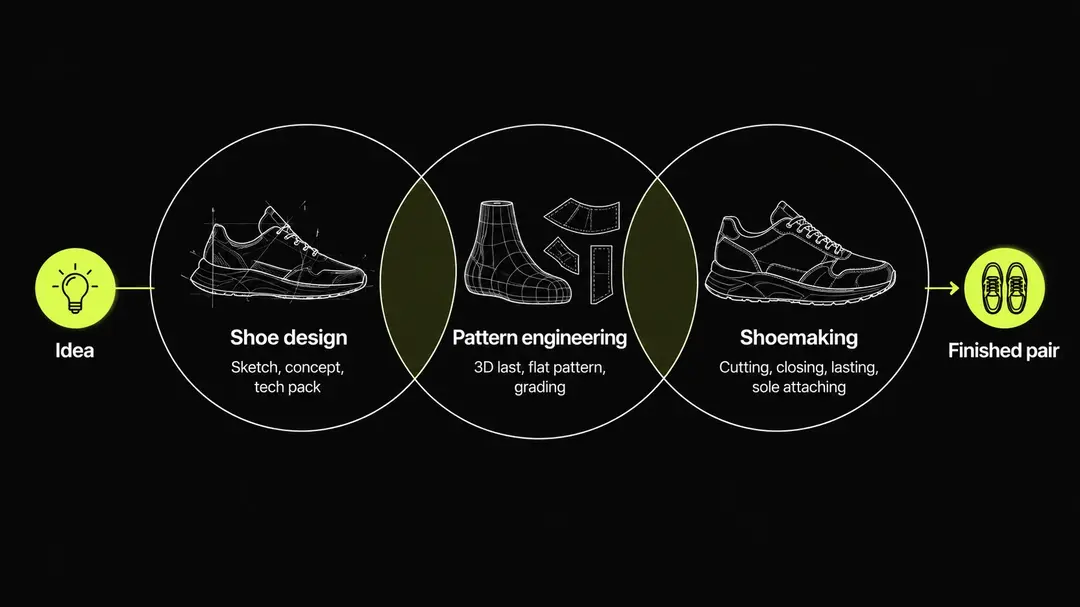
Shoe design courses teach you to conceive and specify a shoe on paper or on screen. Shoemaking courses teach you to build one with your hands: cutting, stitching, lasting and attaching the sole. Searchers often mix the two, but the skills, tools and career outcomes differ.
Here's the simplest way to see it. A designer's deliverable is information: a drawing, a pattern, a tech pack. A shoemaker's deliverable is an object: a pair of shoes. Most design errors I see in the studio are really errors about what the making process will tolerate.
There is a third discipline in the middle, pattern engineering. It turns a design into flat, graded pieces that fit a specific last. Our guide to shoe pattern making covers it in depth. Many "design" courses barely touch it, and many "shoemaking" courses teach it only for one handmade pair.
What Types of Schools for Shoe Design Exist?
Seven types of schools for shoe design and shoe design programs exist, and they differ mainly in what you produce at the end. A degree gives you a credential and a concept portfolio. A technical school gives you production skills. Workshops give you a handmade pair. Each one is built for a different goal.
One caveat before the details. Footwear has no licensing body, so no qualification is legally required to work as a designer or pattern engineer. Recognition comes from academic standing, industry reputation or software-vendor certification, and from the work you can show. The costs below are broad ranges from general market knowledge. They vary a lot by country, so check current prices yourself.
1. University degrees in footwear or accessory design
Colleges for shoe design, usually inside fashion or product-design departments, offer these degrees.
Who it's for: school leavers or career changers who want a creative, brand-side role and a recognised credential.
What you learn: design methodology, research, concept development, drawing, critique and presentation. Construction and pattern work are included but usually secondary.
Duration and cost: typically three to four years. This is the most expensive route, often tens of thousands in total, though public universities in some countries cost far less.
You end up with: a degree, a concept portfolio and a peer network.
Pros: credential, network, strong creative training. Cons: cost, time, and often limited technical depth on patterns and production.
2. Technical and vocational footwear schools
Who it's for: people who want a technical career in a footwear district: pattern-maker, product developer, technical-office role.
What you learn: construction, materials, pattern engineering and the manufacturing process, taught by people with production experience.
Duration and cost: usually several months to two years. Expect costs in the thousands, sometimes subsidised in regional industrial areas.
You end up with: a diploma, a developed model and often a graded pattern.
Pros: employable technical skills, industry contacts. Cons: fixed schedules and in-person attendance, and the software taught may lag behind what factories run.
3. Private design academies (short, intensive, in person)
Who it's for: career changers and early-career designers who want an intensive, mentored programme without a multi-year commitment.
What you learn: a compressed mix of design, basic construction and portfolio building, usually in groups.
Duration and cost: weeks to a few months. Costs often sit in the low-to-mid thousands, plus travel and living if you relocate.
You end up with: a certificate and a portfolio, sometimes a sample pair.
Pros: momentum, feedback, networking. Cons: cost per week is high, and a short programme cannot cover both design and deep pattern engineering.
4. Online specialised 3D and CAD footwear courses
Who it's for: people who want a technical workflow but cannot relocate or pause their job.
What you learn: professional footwear software: importing a last, modelling an upper and sole in 3D, flattening to a pattern, grading and rendering.
Duration and cost: typically weeks to a few months at your own pace. Structured professional courses generally sit between several hundred and a few thousand, and software licences may be separate.
You end up with: a modelled, flattened and graded shoe, plus renders for a portfolio.
Pros: flexible, matches how modern technical offices work. Cons: no hands-on material feel, and quality varies a lot between providers.
5. Generalist online platforms (broad video courses)
Who it's for: curious beginners testing interest at minimal cost.
What you learn: an overview, usually sketching, general concepts or a single tool, often in a hobbyist or generalist 3D program.
Duration and cost: a few hours to a few dozen hours. Usually the cheapest paid tier.
You end up with: a few exercises, rarely a complete developed model.
Pros: cheap, easy to start. Cons: broad rather than deep, little feedback, and rarely the professional footwear tools technical offices use.
6. Hands-on shoemaking workshops and classes
Who it's for: hobbyists, craft enthusiasts and aspiring makers who want to build shoes by hand.
What you learn: cutting, stitching, lasting, sole attachment and finishing, usually on one or two simple styles.
Duration and cost: from a weekend to several weeks, often priced from a couple of hundred up to a few thousand depending on length and materials.
You end up with: a pair of handmade shoes, and a real feel for materials.
Pros: tactile understanding that improves any designer. Cons: it will not make you employable as a designer, and it rarely covers grading or industrial production.
7. Self-teaching with free resources
Who it's for: self-motivated beginners with time and curiosity but little budget.
What you learn: whatever you assemble yourself: tutorials, books, forums, open-source tools.
Duration and cost: open-ended, and free apart from materials and any software you buy.
You end up with: exactly what you build. Sometimes a lot, often gaps.
Pros: zero cost, total freedom. Cons: no structure, no feedback, and it is easy to miss fundamentals such as last logic or grading.
For background reading while you self-teach, Wikipedia's shoemaking page gives a decent historical overview, and SATRA, the UK footwear technology body, publishes technical material on footwear testing and standards.
How Do Shoe Design Classes Compare Side by Side?
Shoe design classes differ most on three things: duration, depth of technical content and what you produce at the end. The table below compares all seven categories at a glance. Costs are broad, hedged ranges, not quotes, and they vary widely by country and provider.
| Category | Mostly teaches | Typical duration | Cost range (broad) | You finish with |
|---|---|---|---|---|
| University degree | Design and concept | 3-4 years | Tens of thousands (varies a lot) | Degree, concept portfolio |
| Technical/vocational school | Pattern engineering, construction | Months to 2 years | Thousands | Diploma, graded pattern |
| Private academy | Mixed design and basics | Weeks to months | Low-to-mid thousands | Certificate, portfolio |
| Online 3D/CAD course | Digital pattern workflow | Weeks to months | Hundreds to low thousands | Modelled, graded shoe, renders |
| Generalist platform | Overview, single tools | Hours to dozens of hours | Lowest paid tier | A few exercises |
| Shoemaking workshop | Handcraft | Weekend to weeks | Hundreds to a few thousand | A handmade pair |
| Self-teaching | Whatever you choose | Open-ended | Free to low | Your own projects |

To judge a specific syllabus, use our checklist for choosing a footwear design course.
How Do You Choose a Shoe Design Course by Goal?
Choose by the output your goal demands, not by the course title. A brand designer needs a concept portfolio, a technical-office professional needs a graded pattern, a brand founder needs both plus production knowledge, and a hobbyist needs enjoyment. Work backwards from the job you want.
Become a designer at a brand
A degree or a private academy fits best, because brand-side roles weight portfolio, point of view and network. Add technical literacy on top: even designers who never draw a pattern benefit from understanding construction. How to become a 3D footwear designer maps the career path in more detail.
Work in a technical office
Technical or vocational schools and online 3D/CAD courses are the strongest options. Technical offices hire for pattern engineering and fluency in footwear CAD. In our experience, a graded pattern in professional software is a far better calling card than a certificate.
Launch your own brand
You need an unusual mix: enough design skill to define a line, enough technical knowledge to brief a factory, and ideally an understanding of production. A technical or online CAD course plus a short making workshop is a practical combination. Skipping the technical side is the costliest mistake, since your factory will not fix a poorly specified pattern for you.
Make shoes by hand
Shoemaking workshops and classes are the right choice. Look for programs where you build a complete pair, not a single component. A technical school can follow if you want to move toward production.
Learn as a hobby
Start with a generalist platform, free resources or a short workshop. Keep the budget small until you know what you enjoy. If you later want to go deeper, how to learn 3D shoe design describes a self-paced route.
Are Online Shoe Design Courses Worth It?
An online shoe designing course is worth it when it teaches a complete workflow in professional footwear software and end in a finished piece of work. It is less useful as loose tutorials in a hobbyist tool. The format is not the issue. The syllabus and the software are.
Footwear CAD suits screen-based teaching: modelling an upper on a last, flattening it, grading across sizes. What online cannot give you is the feel of leather stretching over a last. That's why I often suggest pairing an online technical course with a short hands-on workshop.
If you are weighing the tools themselves, the best software for shoe design comparison explains what each program does and does not cover.
Where Does 3DFootwear Academy Fit?
3DFootwear Academy is one option in the fourth category: an online, self-paced course in Icad Universe, the footwear CAD developed by INESCOP in Elche, Spain. It takes you from importing a 3D last through upper design and flattening to a graded pattern and a render.
It suits people who want the technical-office workflow and need to study around a job. Subtitles are available in Italian, English and Spanish. It is not the right choice if you want to learn handcraft, a university credential or a classroom group. For those goals, categories 1, 2 and 6 fit better.
I built the course around one question: what can you produce on the last day? Here it is a modelled, flattened and graded shoe.
FAQ
What is the best way to learn shoe design?
It depends on your goal. For a brand-side design role, a degree or academy plus a strong portfolio works well. For a technical role, a technical school or an online CAD course that ends in a graded pattern is more direct. For handcraft, choose a shoemaking class. Match the format to the output you need.
How long are shoe design programs?
Durations vary widely by format. University degrees take three to four years, technical schools months to two years, and private academies weeks to a few months. Online 3D courses run weeks to months at your own pace, while shoemaking workshops range from a weekend to a few weeks.
Can I learn shoe design online?
Yes, particularly the digital side: 3D modelling, flattening, grading and rendering. Footwear software is taught well on screen. What online cannot replace is hands-on material experience, so many learners combine an online technical course with a short in-person workshop to feel how leather and lasts behave.
Do I need a degree to design shoes?
No. Footwear has no licensing body, and technical roles in particular hire on demonstrated skill. A degree helps for creative and brand-side positions. For pattern engineering or product development, a technical diploma or focused course plus a strong body of work can be a faster, cheaper route.
What is the difference between shoe design and shoemaking?
Shoe design is conceiving and specifying a shoe: concepts, patterns, tech packs. Shoemaking is physically building it: cutting, closing, lasting and sole attaching. They are complementary, since understanding making improves design, but they lead to different careers and need different training.
How much do shoe design courses cost?
Costs range from free (self-teaching) to tens of thousands (degrees). Technical schools usually cost thousands, structured online professional courses hundreds to low thousands, and workshops a few hundred to a few thousand. Check current prices locally, and ask whether a software licence is included, since that can be a separate cost.
Choosing, Practically
There's no single best course, only the best match for a goal. Decide what you want to hold at the end, a portfolio, a graded pattern or a pair of shoes, then pick the category that produces it.
I'm Susanna Zampieri, a 3D footwear designer, official Icad Universe trainer and iCad Brand Ambassador. If the online technical route is the one you need, the 3DFootwear Academy 3D footwear design course covers the full workflow from last to graded pattern to render, at your own pace.