What Is a Midsole? Materials, Hardness and Design
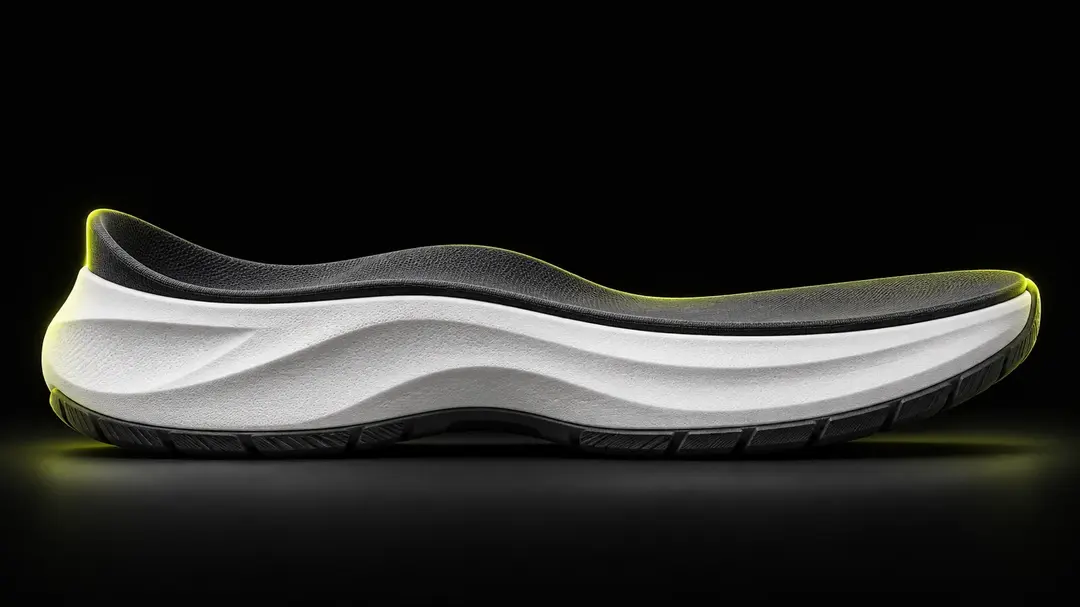
Most explanations of the midsole come from running-shoe reviews: more foam, more bounce, more money. That is useful if you are choosing a pair to run in. It says very little about what the midsole actually is as a component, or what a designer has to decide before one can be made.
This article looks at it from the other side of the table: where the midsole sits in the shoe, which materials are used and why, what the numbers on a spec sheet mean, and how the part is modelled in 3D and written into a tech pack.
Key Takeaways
- A midsole is the layer between the insole board (or insole) and the outsole. It provides cushioning, support and much of the shoe's shape and feel underfoot.
- EVA is the most common midsole foam. Compression-molded and injected EVA behave differently in cost, finish and tooling.
- PU, TPU (including expanded TPU) and PEBA foams trade weight, energy return and durability against each other. No foam wins on every measure.
- Hardness is specified in Asker C (foams) or Shore A (solid rubber and TPU). Stack height and heel-to-toe drop are separate decisions with their own dimensions.
- Not every shoe has a foam midsole. Welted shoes use a leather midsole or a filler, and many cupsole shoes have no distinct midsole at all.
What Is a Midsole?
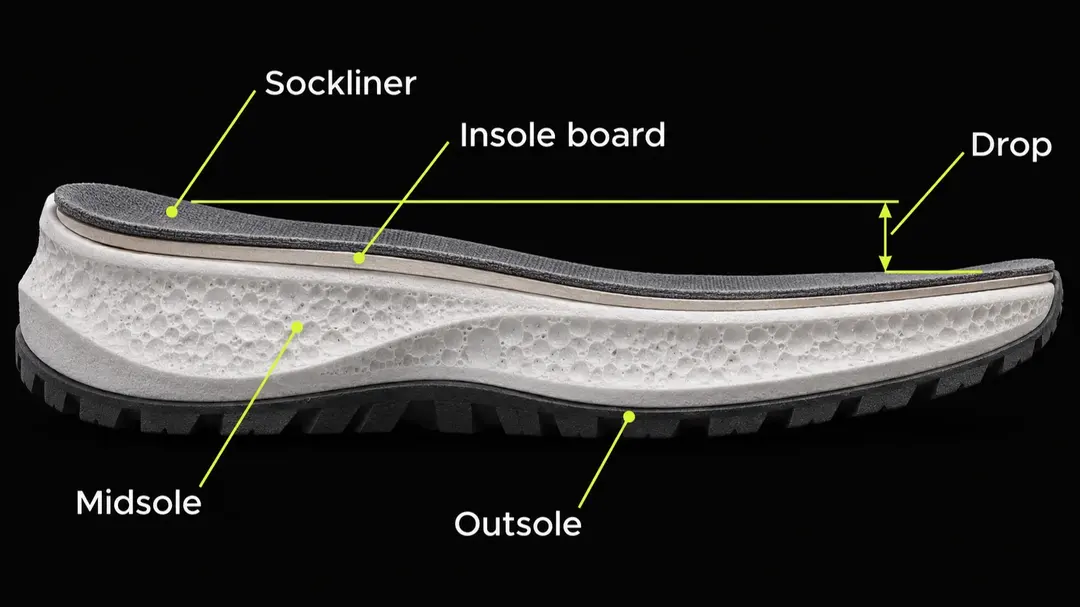
A midsole is the layer of a shoe that sits between the insole (or insole board) and the outsole, and its job is to absorb impact, add support and give the shoe its underfoot character. In most athletic and casual shoes it is a molded foam. In traditional welted shoes it can be a leather layer or a cork filler instead.
The foot never touches the midsole directly in most designs: the insole or sockliner is on top and the outsole is underneath, which is why the midsole is often described as the "hidden" part of the shoe. Yet it controls cushioning, stability, weight, flexibility and, in many sneakers, a large share of the visual identity.
Midsole vs insole vs outsole
The three layers are easy to confuse because the words are so similar. Each one has a different function and is made from a different material family.
| Layer | Position | Main function | Typical materials |
|---|---|---|---|
| Insole / sockliner | Directly under the foot | Comfort, moisture management, fit | Foam, leather, textile-covered EVA |
| Insole board (lasting board) | Under the insole, attached to the upper during lasting | Gives the shoe its base shape; the upper is lasted onto it | Cellulose board, fibreboard, Texon-type materials |
| Midsole | Between insole board and outsole | Cushioning, support, shape | EVA, PU, TPU, PEBA, leather, cork |
| Outsole | Contacts the ground | Grip, wear resistance | Rubber, TPU, leather, EVA with a rubber skin |
For the full vocabulary of the shoe, including where each of these parts sits relative to the upper and the last, see the parts of a shoe. For the wider family of bottom units, see the types of shoe soles.
Where the Midsole Sits in Different Constructions
The midsole is not a fixed layer that every shoe has. Whether it exists, what it is made of and how it is attached depend on the construction method, and that is the first thing a designer has to settle.
Sneakers and running shoes
In a cemented sneaker the midsole is usually a single molded foam unit, glued to the lasted upper, with a rubber or TPU outsole glued underneath. Sometimes the outsole is a thin pad under the midsole only where wear happens, and some running shoes expose the foam almost everywhere.
Cupsole and vulcanized shoes
A cupsole is a one-piece rubber or compound unit with a raised wall that wraps the upper. It often has an insole board and a thin foam layer inside it, so the "midsole" is a filler rather than a distinct visible part. Vulcanized soles are built differently again, and are discussed in the construction methods article.
Welted shoes: leather midsole and cork filler
In a Goodyear-welted shoe the sequence is insole, a gap, then the outsole. The welt is stitched to a rib on the insole and to the upper, and the outsole is stitched to the welt. The gap inside the welt has to be filled, and cork filler is the traditional material for it. In some constructions a leather midsole is added between the filler and the outsole, which gives a thicker, more rigid base.
That is why the term "midsole" means something different in a dress shoe workshop than in a running-shoe lab, and why it is worth checking which meaning a spec or a supplier is using.
What Are Midsoles Made Of?
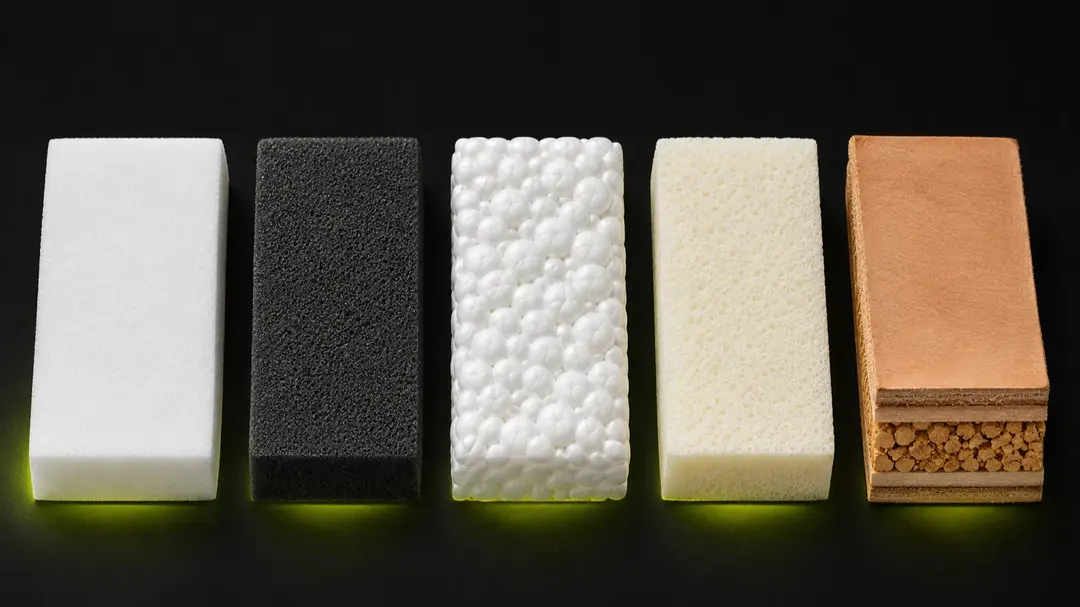
Midsole materials are mostly foams, and the main families are EVA, PU, TPU and PEBA. They differ in density, resilience, durability and processing, and the right choice depends on the shoe's purpose and price point.
EVA (ethylene-vinyl acetate)
EVA is a copolymer that is expanded into a closed-cell foam and is the default midsole material across the industry. It is light, easy to process and cheap compared with newer foams. Its weakness is compression set: with repeated loading the cells flatten and the foam loses part of its original cushioning.
There are two main ways to make an EVA midsole.
- Compression-molded EVA. A pre-cut slug of EVA is heated and pressed in a mold, then allowed to expand. It is the classic route for sneaker and sandal midsoles, and it suits smaller runs and complex outer surfaces, but each cycle is slow.
- Injection-molded EVA. Foamed EVA compound is injected into a closed mold. It is faster per part and well suited to high volume, but the tooling is more expensive and the result usually has a different surface and density profile.
Many "EVA midsole" search results do not say which of the two is meant, yet it changes the unit cost, the tooling cost and how fine a surface detail can be reproduced.
PU (polyurethane)
PU midsoles are poured or injected as a reactive liquid that cures in the mold. Polyurethane is denser and more durable than EVA and keeps its shape longer, which is why it is common in work boots, hiking shoes and some classic sneakers. The cost is weight: for the same hardness a PU midsole is generally heavier.
TPU and expanded TPU (e-TPU)
Thermoplastic polyurethane can be used solid, for example as an outsole or a shank, or as a foam made of expanded beads fused together. Expanded TPU has strong energy return and holds up well over time and across temperatures. It is typically heavier than the lightest EVA and PEBA foams.
PEBA foams
PEBA (polyether block amide) foams are the light, high-rebound option used in performance running shoes. They return more energy per compression than conventional EVA and weigh little, but they cost more, and durability and grip depend heavily on the specific formulation and on the outsole paired with them.
Foam comparison
The table below summarises general tendencies. Actual figures vary by supplier and formulation, so treat it as a starting point for a conversation with a material supplier, not as a datasheet.
| Foam | Weight | Energy return | Durability | Cost | Typical use |
|---|---|---|---|---|---|
| Compression-molded EVA | Low | Moderate | Moderate (compression set over time) | Low to medium | Sneakers, sandals, casual |
| Injected EVA | Low | Moderate | Moderate | Low per part at volume | Mass-market sneakers, slides |
| PU | Higher | Moderate | High | Medium | Work boots, hiking, retro sneakers |
| TPU / e-TPU | Medium to high | High | High, stable across temperatures | Medium to high | Running and lifestyle sneakers |
| PEBA foam | Very low | Very high | Variable by formulation | High | Performance running |
| Leather midsole | High | None | High | Medium | Welted dress shoes and boots |
| Cork filler | Low | Low | Moderate | Low | Welted shoes (cavity filler) |
Hardness: Asker C, Shore A and What the Numbers Mean
Hardness is the first number a factory will ask for, and it is measured on a durometer scale. Foams are normally given in Asker C, a scale developed for soft cellular materials, while solid rubber and TPU are given in Shore A. The two scales are not interchangeable, and a value quoted without its scale is ambiguous. The general principle of durometer measurement is the same: an indenter is pressed into the material and the depth is converted to a number.
In practice the designer is balancing three things:
- Softer foam feels more cushioned in the first seconds but can bottom out and feel unstable under load.
- Harder foam is more stable and durable but can feel flat and unforgiving.
- Dual-density midsoles combine both, usually with a firmer insert on the medial side of the heel to resist rolling inward.
As a rough working reference, many casual and running EVA midsoles fall somewhere in the middle of the Asker C range, with softer values for comfort models and firmer values for stability or heavy-use shoes. I would not quote a single "correct" number: it depends on the foam, the thickness and the wearer. Ask the supplier for sample plaques and test in the shoe rather than on paper.
Stack Height and Heel-to-Toe Drop
Stack height is the total thickness of the sole unit under the foot, and heel-to-toe drop is the difference between the heel stack and the forefoot stack. Both are dimensions the designer sets, and both change how the shoe behaves and how the proportions look.
- Heel stack height: the thickness under the centre of the heel, measured in millimetres.
- Forefoot stack height: the thickness under the ball of the foot.
- Heel-to-toe drop: heel stack minus forefoot stack. A shoe with a 30 mm heel stack and a 22 mm forefoot stack has an 8 mm drop.
Drop is a design variable rather than a quality grade. Lower-drop shoes put the foot closer to flat and higher-drop shoes tilt it forward. Neither is "better" for every wearer, and any claim about injuries or running mechanics should come from the research literature rather than from a sole design brief.
Drop also matters because it is tied to the last. The last's heel height defines the angle of the footbed, and the sole unit has to be built to match. If you want to see how this connects, the 3D sole and heel design guide covers the relationship between the last, the heel and the bottom unit.
How a Midsole Is Modelled in 3D
In 3D, the midsole is not drawn as a block: it is built from the last. In the studio, I start from the bottom of the last, its footbed and its feather edge, and construct the sole unit around it so that the top surface of the midsole matches the lasted insole exactly. Any gap or overlap there becomes a visible defect on the sample.
The usual sequence looks like this:
- Import the last and fix the reference planes (heel point, ball line, toe spring).
- Define the footprint: the outline of the sole unit, including any overhang beyond the upper.
- Build the top surface by offsetting the lasted bottom, so the midsole meets the insole board without gaps.
- Set the stack: heel and forefoot thickness from the spec, with a smooth transition between them.
- Add the details: sidewall shape, grooves, cavities, inserts, and the area where the outsole will attach.
- Check manufacturability: draft angles so the part releases from the mold, minimum wall thicknesses, and no undercuts that need extra mold parts.
The same model is what the toolmaker uses. A well-built midsole file can go straight to mold design, and the left and right units, plus each size in the range, need to be graded so the proportions stay correct. For a broader look at sole modelling workflows, the sole and heel design article is the closest companion to this one.
How a Midsole Is Written Into a Tech Pack
A midsole that is not written down gets decided by the factory. In the tech pack it normally appears in the sole section, and the more of the following is specified, the fewer sample rounds it takes.
- Material and process: for example "EVA, compression-molded" or "PU, injected", not just "foam".
- Hardness: the value, the scale (Asker C or Shore A) and the tolerance.
- Colour: a reference to a colour standard, plus whether the colour is through the material or painted.
- Dimensions: heel and forefoot stack, drop and overall length per size.
- Construction: how it attaches to the upper and the outsole, and which adhesive or process is used.
- Inserts and cavities: any dual-density zones, shanks, plates or air units, with their positions.
- Files: the 3D model or the 2D drawings of the sole unit, per size where needed.
FAQ
What is the difference between a midsole and an insole?
The insole (or sockliner) is the layer your foot rests on, chosen for comfort and fit, and it is usually removable. The midsole is below it, between the insole board and the outsole, and it provides the structural cushioning and support. In many shoes the midsole is permanently attached and cannot be taken out.
Is EVA a good midsole material?
EVA is a good all-round midsole material because it is light, easy to mold and inexpensive. Its limit is that it compresses permanently over time, so it loses some cushioning with use. Whether it is "good" depends on the shoe: it is well suited to casual shoes, sandals and many sneakers, while performance running shoes often use more resilient foams.
What is the difference between compression-molded and injected EVA?
Compression-molded EVA is heated and pressed in a mold from a pre-cut slug, which suits smaller runs and complex shapes. Injected EVA is shot into a closed mold, which is faster per part and better for volume but needs more expensive tooling. They can feel and look different even at the same nominal hardness.
What does a leather midsole do?
In a welted shoe, a leather midsole adds thickness and rigidity between the insole and the outsole and helps the shoe keep its shape. It does not cushion like foam. Cork is used alongside it, or instead of it, as a filler for the cavity left inside the welt.
Do all shoes have a midsole?
No. Many cupsole shoes, vulcanized shoes and simple flats have a one-piece sole with no separate midsole, or only a thin foam layer inside. The term applies most clearly to sneakers, running shoes and welted shoes.
How is midsole hardness measured?
Foam midsoles are measured with a durometer on the Asker C scale, and solid rubber or TPU on the Shore A scale. A value should always be written with its scale, because the numbers are not interchangeable between them.
Designing the Midsole in Practice
The midsole is one of the places where a shoe's drawing, its last, its material and its factory meet, and the decisions made there are hard to change once the mold is cut. Learning to build the sole unit from the last in 3D, with the right stack, drop and mold logic, is part of the workflow taught in the 3D footwear design course.