Types of Shoes: A Complete Guide by Style, Construction and Use
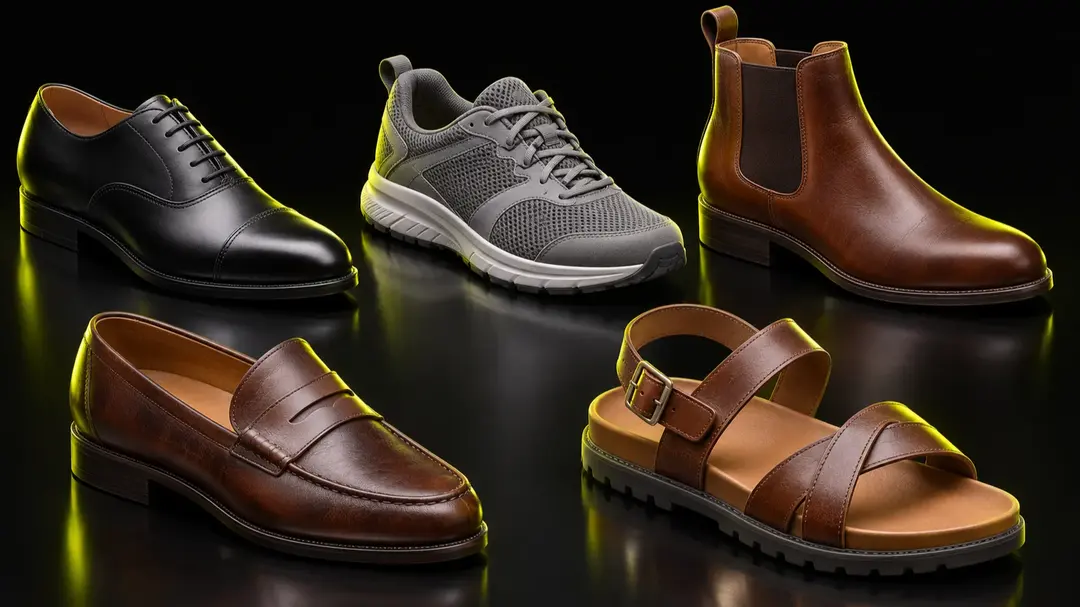
Search "types of shoes" and you get a glossary of styles: oxford, loafer, pump, sneaker. It helps you recognise a name, but it does not explain why a derby and an oxford are different shoes, or why two pairs that look identical can cost very different amounts to make.
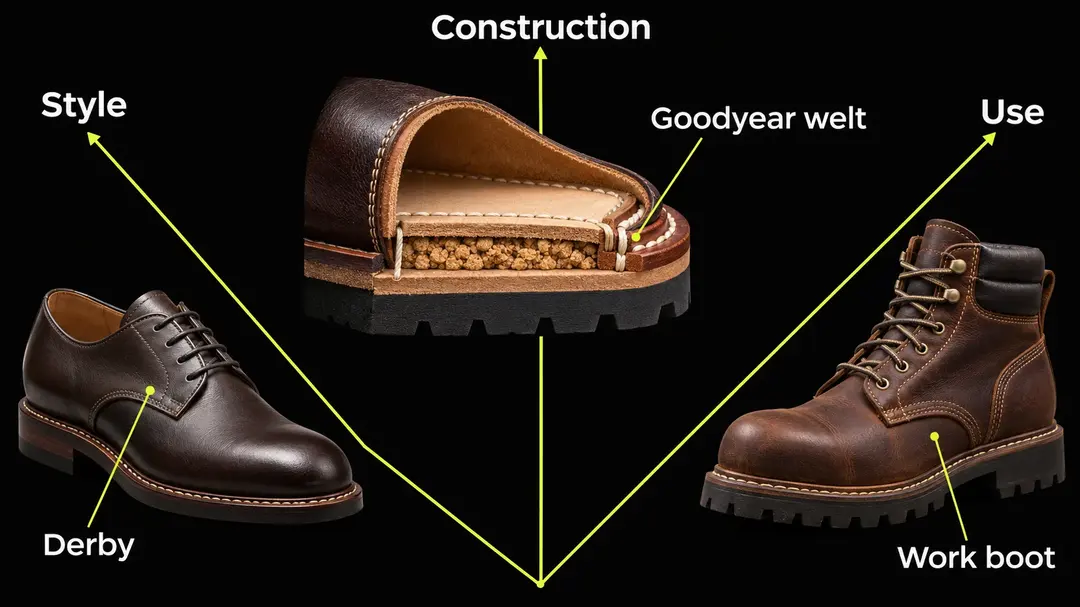
Footwear professionals do not sort shoes by style alone. They use three axes that cross: the style of the upper, the construction that joins upper and bottom unit, and the intended use. This guide organises the types of shoes that way, from the pattern-maker's desk, where each difference is a piece that gets cut another way.
Key Takeaways
- Shoes are classified on three independent axes: style (the upper pattern), construction (how upper and sole are joined) and use (what the shoe is for).
- Oxford and derby differ by one pattern detail: the quarters are stitched under the vamp (oxford, closed) or on top of it (derby, open).
- Construction (cemented, strobel, Blake, Goodyear, vulcanized) changes durability, flexibility and price more than the style name does.
- The same style can be built several ways: a derby can be cemented or Goodyear-welted.
- Use (dress, casual, athletic, work, orthopedic, children's) adds technical requirements and standards that shape the design.
What Are the Types of Shoes and How Are They Classified?
The types of shoes are the categories footwear is grouped into by three criteria: the style of the upper, the construction that joins the upper to the sole, and the use the shoe is made for. Any shoe can be described by picking one value on each axis, for example "derby, Goodyear welt, dress".
That is how a technical office actually works. When a prototype is ordered, "a classic shoe" is not enough: you have to fix the style (which pattern), the construction (how it is assembled) and the use (what it must withstand). For a general overview of names, see the Wikipedia article on shoes.
| Axis | Question it answers | Examples |
|---|---|---|
| Style | How is the upper cut and closed? | Oxford, derby, loafer, Chelsea boot, sandal |
| Construction | How is the upper joined to the sole? | Cemented, strobel, Blake, Goodyear, vulcanized |
| Use | What is it made for? | Dress, casual, athletic, safety, orthopedic |
Separating the axes avoids confusion. "Boot" is a style, "Goodyear" is a construction and "work" is a use, and all three can describe one shoe. To check the names of each component before going further, read the parts of a shoe.
What Are the Types of Shoes by Style?
By style, shoes divide into families distinguished by the pattern of the upper: how many pieces it has, where it closes and how much of the foot it covers. This table is the quick answer, grouped by category, with the construction or last detail that sets each apart.
Types of shoes chart by category
| Category | Shoe type | What defines it in the pattern, last or construction | Typical construction |
|---|---|---|---|
| Dress | Oxford | Quarters stitched under the vamp, closed lacing | Goodyear, Blake |
| Dress | Derby (Blucher) | Quarters stitched over the vamp, open lacing | Goodyear, Blake, cemented |
| Dress | Monk strap | Closes with a buckled strap across the instep, no laces | Goodyear, Blake |
| Dress | Brogue | Oxford or derby with perforated decoration | Goodyear |
| Dress | Pump (court shoe) | Low-cut vamp, closed heel, heeled last | Cemented |
| Casual | Loafer | Continuous vamp, saddle strip over the instep, no closure | Blake, cemented |
| Casual | Boat shoe | Moccasin-style upper, siped rubber sole | Cemented, stitched |
| Casual | Espadrille | Textile upper, jute or rope sole | Stitched, cemented |
| Casual | Slip-on | Elastic gussets or a low vamp, no laces | Cemented |
| Athletic | Sneaker | Multi-piece upper, tongue, foam midsole | Strobel, cemented, cupsole |
| Athletic | Running shoe | Light mesh upper, thick midsole, flat sole | Strobel |
| Athletic | Court or tennis shoe | Reinforced toe and sides, durable outsole | Cemented, cupsole |
| Boots | Chelsea boot | Ankle boot with elastic side panel | Goodyear, Blake, cemented |
| Boots | Chukka | Low ankle boot, two or three eyelet pairs | Cemented, Goodyear |
| Boots | Work or hiking boot | Tall shaft, reinforced toe, lugged sole | Cemented, injected, Goodyear |
| Boots | Cowboy boot | Tall shaft, Cuban or angled heel, pointed toe | Stitched, welted |
| Sandals | Flat sandal | Straps over a base, foot exposed | Cemented |
| Sandals | Flip-flop | Single strap between toes, flat base | Moulded |
| Sandals | Slide | Open-back with a single wide band | Moulded, cemented |
| Slippers | House slipper | Soft upper, lightweight sole | Cemented, stitched |
| Slippers | Mule | Open back, covered front | Cemented |
| Slippers | Clog | Thick sole, often wood or moulded, open back | Moulded, stitched |
The names overlap in everyday talk, so confirm what the other person means. "Slipper" is an indoor shoe in the US but can mean a lightweight flat elsewhere, and "clog" covers both wooden styles and moulded foam ones.
Lace-up dress shoes: oxford and derby
The oxford has its quarters stitched under the vamp, so the eyestay closes and the throat forms a "V". The derby has its quarters stitched over the vamp, leaving the eyestay open. That is the most quoted difference and the easiest to check.
The small pattern change has consequences. A derby opens wider and tends to suit a higher instep, while an oxford gives a cleaner line and reads as more formal. To see how these pieces are built, read how to model a shoe upper in 3D.
Loafers, monks and other slip-on styles
A monk strap closes with one or two buckles instead of laces, on a pattern close to a derby or oxford. A loafer has no closure: it stays on through the fit of the vamp and often carries a saddle strip sewn across the instep. Both are low shoes but solve the fit differently.
Sneakers and athletic shoes
The sneaker pairs a multi-piece upper with a rubber or foam bottom unit. Athletic shoes are where the bottom unit does the engineering, with midsole foams, plates and outsole patterns. Dedicated guides cover what is a midsole and, in the same family, vulcanized vs cupsole constructions.
Boots
A boot covers the ankle or more, and an ankle boot stops at the ankle bone. Within the family there are patterns of their own: the Chelsea has elastic side panels and no laces, and the chukka is a low boot with two or three pairs of eyelets, often in suede. The full family is in types of boots.
Sandals and slippers
Sandals leave the foot exposed and hold it with straps, so the last and the footbed matter as much as the upper. Slippers are soft, light shoes for indoors or easy wear, and their patterns are among the simplest in the catalogue. Heeled models have their own classification in types of heels.
What Types of Shoe Construction Exist?
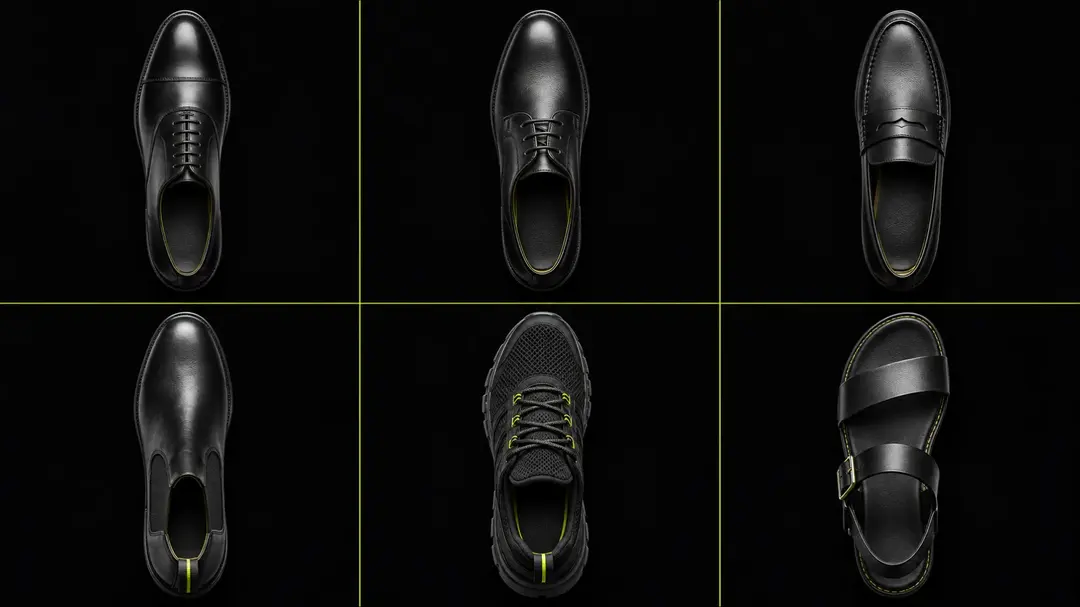
Construction is the method that joins the upper to the bottom unit, and it governs durability, flexibility, weight and price. The most common are cemented, strobel, Blake, Goodyear welt and vulcanized. Each applies to several styles, so they should not be mistaken for the styles themselves.
Construction often matters more than the style name. Two oxfords that look the same can be a throwaway shoe or one that is resoled many times, and much of the difference is here. How shoes are made places each method in the full process, and shoe construction methods compares them in depth.
| Construction | How the sole is joined | Main trait |
|---|---|---|
| Cemented | Adhesive between upper and sole | Light, economical, hard to repair |
| Strobel | Upper stitched to a sock-like board, then glued | Very flexible, common in athletic shoes |
| Blake | One stitch through sole, upper and insole | Slim profile, flexible, resolable |
| Goodyear welt | Stitched to a welt attached to the upper, then to the sole | Very durable, resolable several times |
| Vulcanized | Rubber cured with heat and pressure on the upper | Bonded, flexible; classic canvas sneaker |
Cemented, strobel and vulcanized: the industrial logic
Cementing is the most widespread construction because it is quick and cheap: the sole is glued on after the surfaces are prepared. Strobel stitches the upper's bottom edge to a thin board and then bonds the sole, which gives flexibility. In vulcanizing, rubber cures under heat and pressure and bonds to the upper. All three suit long runs.
Blake and Goodyear: the craft logic
Blake stitches the sole straight to the upper through the lasting insole, which allows a narrow profile. Goodyear adds a welt, an intermediate strip: the upper is stitched to it and then the sole to the welt. It costs more but lets the shoe be resoled several times. The history of the method is covered on Goodyear welt on Wikipedia.
In my experience the construction has to be decided before the pattern is drawn, not after. A Goodyear shoe needs a different lasting allowance and insole than a cemented one, and discovering that with the prototype in hand means remaking pieces. It also affects the last, since the bottom unit's volume changes the fit.
What Types of Shoes Are There by Use?
By use, shoes group into dress, casual, athletic, safety or work, orthopedic and children's. Each group answers different technical requirements, and some are regulated: safety footwear, for instance, must pass tests such as toe-cap impact resistance.
Use is the axis that fashion lists show least and that shapes the design most. A shoe for an office is not designed like one for a factory floor. For standards and testing on footwear by function, SATRA is a useful reference.
| Use | Design priority | Typical styles and constructions |
|---|---|---|
| Dress | Aesthetics, clean line, formality | Oxford, derby, monk; Goodyear or Blake |
| Casual | Comfort and versatility | Loafer, chukka, sneaker, espadrille; cemented |
| Athletic | Cushioning, weight, support | Technical sneaker; strobel, cemented, injected |
| Safety / work | Protection, durability, grip | Boot or ankle boot with reinforced toe; cemented or injected |
| Orthopedic | Support, offloading, custom fit | Roomy styles, specific lasts, insoles |
| Children's | Growth, flexibility, light weight | Sneaker, sandal, boot; cemented |
Safety, orthopedic and children's: where design turns technical
In safety and work footwear the reinforced toe cap and non-slip sole are not optional, and they set the last volume and the final look. In orthopedic footwear the shoe adapts to the foot, not the other way around. In children's shoes, flexibility and a fit that allows for growth come first. If I have learned one thing from developing patterns, it is that use outranks style.
How Do Style, Construction and Use Relate?
In practice the three axes are not independent: use restricts which constructions make sense, and construction limits which styles are viable. A dress oxford is usually Goodyear or Blake, and an athletic sneaker usually strobel or cemented. Exceptions exist and are common.
Thinking in three axes avoids typical mistakes. A request for "an elegant work boot" combines a style (boot), a use (work) and an aesthetic demand that clashes with a safety toe cap, so something has to give.
| Combination | Example | Why it works |
|---|---|---|
| Oxford + Goodyear + dress | Classic office shoe | Slim line, durable, resolable |
| Derby + cemented + casual | Everyday mid-price shoe | Comfortable, light, good volume |
| Boot + Goodyear + work | Heavy-duty work boot | Takes hard use and can be repaired |
| Sneaker + strobel + athletic | Running shoe | Flexible and light |
| Loafer + Blake + casual | Summer loafer | Narrow profile and flexible |
In 3D work this translates directly: the style defines the upper pieces, the construction defines the bottom unit shape and allowances, and the use defines the requirements checked on the prototype. It is the same split a well-made tech pack follows.
FAQ
How many types of shoes are there?
There is no single number, because it depends on the criterion. By style there are about a dozen main families (oxford, derby, monk, loafer, boot, ankle boot, sneaker, sandal, pump, mule, slipper, espadrille and variants), each with subtypes. By construction there are five common methods, and by use, six broad groups.
What is the difference between an oxford and a derby?
It is in the pattern: on an oxford the quarters are stitched under the vamp and the lacing is closed, while on a derby they are stitched over the vamp and the lacing is open. A derby fits higher insteps better, and an oxford has a cleaner, more formal line.
What is the difference between Goodyear and Blake?
Blake stitches the sole directly to the upper through the lasting insole, giving a slim, flexible profile. Goodyear adds an intermediate welt and stitches in two steps, which makes it more durable and easier to resole, but also more expensive and wider.
What type of shoe is best for everyday wear?
It depends on the real use. For a lot of walking, sneakers or loafers with a flexible sole usually work well, and for an office a derby or oxford. More than the style, the last and the construction matter: a good fit and a suitable sole count for more than the name.
What does a Goodyear-welted shoe mean?
It means the upper and sole are joined by a welt, a strip of leather stitched to both. That structure lets the sole be replaced without taking the upper apart, which is why these shoes can be resoled several times. It is common in mid-range and high-end dress footwear and boots.
From Classifying Shoes to Designing Them
Classifying well is the first step to designing well: when style, construction and use are separated, every decision has its place and costly mistakes are avoided. Anyone who wants to go from recognising shoe types to modelling them in 3D will find the full method in the 3D footwear design course, built to teach it from the pattern up.
Susanna Zampieri is a 3D footwear designer with more than ten years in the industry, direct Brand Ambassador of iCad and official trainer of Icad Universe, the footwear CAD developed by INESCOP. She has worked with more than 50 luxury brands and trained more than 100 students. She is the founder of 3DFootwear Academy and of the footwear brand Cocoawant.